Wednesday, August 19, 2009
The Science Behind "Feelie Goop"
I am still fascinated by our Goop experiment that we did the other day. So, I decided to do some research into why Feelie Goop behaves the way it does.
Well it turns out that our "Feelie Goop" is an example of a non-Newtonian fluid...specifically a dilatant.
What is a dilatant? Well, to understand the science behind our "feelie goop" imagine that you are walking through a busy train station full of people walking in the opposite direction. To get across the room, you would have to move slowly and find a path between the people. If you tried to run straight across the room at full speed, you would quickly run into another person stopping you in your tracks. This analogy describes the dilatant effect.
The dilatant effect occurs when closely packed particles (like our cornstarch) are combined with enough liquid to fill the gaps between them. At slower speeds, the liquid acts as a lubricant allowing the substance to flow easily. At higher speeds, the liquid is unable to fill the gaps around the particles which causes a great amount of friction. This causes the increase in viscosity. (The term "viscosity" is used to describe the resistance of a liquid to flow. Water, for example, has a low viscosity and flows easily. Syrup has a higher viscosity and doesn't flow as easily.)
So when we press our fingers slowly into our "feelie goop" it allows the cornstarch to move out of the way. However, when we exert a large amount of pressure into the goop (say striking the goop with a hammer), the solid cornstarch particles are not able to get out of the way and the substance behaves more like a solid.
For more ideas on how to experiment with our non-Newtonian substance, check out this video (Video by OragamiSquared):
Labels:
Playful Learning
Tuesday, August 18, 2009
Playing with Blocks: 10 New Ideas for You to Try with your Toddler
Most children do a very good job of discovering fun uses for their blocks and toys on their own. However, sometimes it can help if they have a parent around who can give them a few ideas for playing with their toys. Sometimes those ideas can take an old, dusty toy and fill it full of new life.
This is hard for me to do as a parent because I have to admit that I didn't spend a lot of time playing with blocks as a child. When I first brought home a set of unit blocks for Marcus, he looked at me expectantly like he was wondering, "What do we do with these?" And I remember thinking the same thing! What did we do with these? Obviously we could stack them. And yes...apparently it is very funny to throw them inside the house. But what was else?
So, for those of you like me who could use some ideas on a few fun games to incorporate more block play with your young toddlers, this list is for you!
Age Appropriateness:
Most young toddlers (around the ages of 1-2 years old) are not going to be into building large complex structures. Mostly they will be into transferring, gripping, stacking, and lining up their blocks. So, here are some fun games/ideas for you to try with your child next time you are playing with blocks. Many of these ideas could very easily be incorporated with your child's favorite books.
Required Reading for Mom:
The Benefits of Playing with Blocks
Stages of Block Play
(See Also Setting up a Block Center in your Home)
IDEA #1: Block Dump Truck
Materials Needed:
- Dump Truck
- Large container full of small Small Cube Blocks

Process:
Put a dump truck next to a can of small cube blocks. Encourage the child to fill the dump truck full of blocks and push it around the room. Most kids will enjoy loading and dumping the trucks loads of blocks over and over again.
IDEA #2: Building a Road
Materials Needed:
- Unit Blocks
- Small Cars
Process:
Start to put some blocks in a row. Experiment with both curved and straight blocks. Drive the car on the road made of blocks and see if your child will copy you. (Again, never force this. Allow them to play with the cars and blocks in their own way.)
IDEA #3: Building a Ramp
Materials Needed:
- Unit Blocks
- Small Cars
- Long board
Process: Build a low and sturdy ramp. Have fun rolling the cars down the ramp.
IDEA #4: Nesting Blocks
Materials Needed:
- Nesting Blocks
Process:
Bring out a set of nesting blocks. (For very young children, only start out with a 3-4 so they don't get overwhelmed.) Let the child take them apart and then show him how to turn them over and stack them. Talk about how the larger ones need to go on the bottom in order to build a sturdy tower.
Marcus learns about "big and little" playing with his nesting blocks.
IDEA #5: Make a Train
Materials Needed:
- Medium Sized Cubed Blocks
Process:
Show the child how to line up several blocks in a row and then push them around the room. Have fun making train sounds.
Marcus's Block Train
IDEA #6: People on a Bus
Materials Needed:
- Large Cardboard Blocks
- Large Wheel (a Paper Plate or Frisby works well)
Process:
Line up several large cardboard blocks in a row. Then, pretend that the row of blocks is a large bus. Siblings and mom and dad can sit on the back blocks to be the passengers. The person sitting on the front block can steer the bus using the wheel. Have fun singing The Wheels on the Bus go round and round.
IDEA # 7: Building a Wall & Playing House
Materials Needed:
- Large Cardboard Blocks
Process:
Help children make an enclosed space (one block high) with the blocks. Leave a gap for the door. Use other blocks for the chairs inside the house. Have fun going in and out of the house. "Knock" on the door and ask "Is anybody home?" and "Can I come in?" before entering the house. Read the story of the three little pigs. Reenact the story using the house that you just built.
Sophia in her "House"
IDEA #8: Building a Bridge
Materials Needed:
- Most any type of blocks (Unit Blocks
, Bristle Blocks
, Duplos
, Mega Blocks
, or Large Cardboard Blocks
)
Process: Build a small bridge using three blocks. See if the child will try to copy them.
Marcus looking though his giant bridge
IDEA #9: Feelie Bag
Materials Needed:
- Small Table Blocks
- Bag
Process:
Place two different block shapes inside a bag. (Choose two that would be easy to tell apart such as a circle and a square.) Ask the child to reach in the bag and find the square.
IDEA #10: Build a zoo
Materials Needed:
- Small Zoo Animals
- Blocks
Process:
Bring out some small zoo animals. Use the blocks to build fences for different animals giving them a place to live. Then, visit a zoo or read a book about the zoo
.
EXTRA CREDIT IDEA #11: Block Idea Book
OK, OK, I know. I said I was going to list 1o ideas for block play, not 11. But, this one is more an idea for the moms.
Materials:
-Camera
-3 Ring Binder with sheet protectors...or a fancy schmancy professionally printed book (like the ones available from shutterfly)
Process: Create a "Block Idea Book" for you child and keep it in their block area. The book will be a wonderful keepsake for you, and will also inspire hours and hours of playing as the child gets older.
To do this, keep a camera near your child's block area at all times. When you find them doing something especially creative with the blocks, snatch a picture for their book. Put the picture in one of the pages of the binder. OR...you can upload the pictures and create a nice, hardbound book to keep near your block area.
This is hard for me to do as a parent because I have to admit that I didn't spend a lot of time playing with blocks as a child.
So, for those of you like me who could use some ideas on a few fun games to incorporate more block play with your young toddlers, this list is for you!
Age Appropriateness:
Most young toddlers (around the ages of 1-2 years old) are not going to be into building large complex structures. Mostly they will be into transferring, gripping, stacking, and lining up their blocks. So, here are some fun games/ideas for you to try with your child next time you are playing with blocks. Many of these ideas could very easily be incorporated with your child's favorite books.
Required Reading for Mom:
The Benefits of Playing with Blocks
Stages of Block Play
(See Also Setting up a Block Center in your Home)
IDEA #1: Block Dump Truck
Materials Needed:
- Dump Truck
- Large container full of small Small Cube Blocks
Process:
Put a dump truck next to a can of small cube blocks. Encourage the child to fill the dump truck full of blocks and push it around the room. Most kids will enjoy loading and dumping the trucks loads of blocks over and over again.
IDEA #2: Building a Road
Materials Needed:
- Unit Blocks
- Small Cars
Process:
Start to put some blocks in a row. Experiment with both curved and straight blocks. Drive the car on the road made of blocks and see if your child will copy you. (Again, never force this. Allow them to play with the cars and blocks in their own way.)
IDEA #3: Building a Ramp
Materials Needed:
- Unit Blocks
- Small Cars
- Long board
Process: Build a low and sturdy ramp. Have fun rolling the cars down the ramp.
IDEA #4: Nesting Blocks
Materials Needed:
- Nesting Blocks
Process:
Bring out a set of nesting blocks. (For very young children, only start out with a 3-4 so they don't get overwhelmed.) Let the child take them apart and then show him how to turn them over and stack them. Talk about how the larger ones need to go on the bottom in order to build a sturdy tower.
Materials Needed:
- Medium Sized Cubed Blocks
Process:
Show the child how to line up several blocks in a row and then push them around the room. Have fun making train sounds.
IDEA #6: People on a Bus
Materials Needed:
- Large Cardboard Blocks
- Large Wheel (a Paper Plate or Frisby works well)
Process:
Line up several large cardboard blocks in a row. Then, pretend that the row of blocks is a large bus. Siblings and mom and dad can sit on the back blocks to be the passengers. The person sitting on the front block can steer the bus using the wheel. Have fun singing The Wheels on the Bus go round and round.
IDEA # 7: Building a Wall & Playing House
Materials Needed:
- Large Cardboard Blocks
Process:
Help children make an enclosed space (one block high) with the blocks. Leave a gap for the door. Use other blocks for the chairs inside the house. Have fun going in and out of the house. "Knock" on the door and ask "Is anybody home?" and "Can I come in?" before entering the house. Read the story of the three little pigs. Reenact the story using the house that you just built.
IDEA #8: Building a Bridge
Materials Needed:
- Most any type of blocks (Unit Blocks
Process: Build a small bridge using three blocks. See if the child will try to copy them.
IDEA #9: Feelie Bag
Materials Needed:
- Small Table Blocks
- Bag
Process:
Place two different block shapes inside a bag. (Choose two that would be easy to tell apart such as a circle and a square.) Ask the child to reach in the bag and find the square.
IDEA #10: Build a zoo
Materials Needed:
- Small Zoo Animals
- Blocks
Process:
Bring out some small zoo animals. Use the blocks to build fences for different animals giving them a place to live. Then, visit a zoo or read a book about the zoo
EXTRA CREDIT IDEA #11: Block Idea Book
OK, OK, I know. I said I was going to list 1o ideas for block play, not 11. But, this one is more an idea for the moms.
Materials:
-Camera
-3 Ring Binder with sheet protectors...or a fancy schmancy professionally printed book (like the ones available from shutterfly)
Process: Create a "Block Idea Book" for you child and keep it in their block area. The book will be a wonderful keepsake for you, and will also inspire hours and hours of playing as the child gets older.
To do this, keep a camera near your child's block area at all times. When you find them doing something especially creative with the blocks, snatch a picture for their book. Put the picture in one of the pages of the binder. OR...you can upload the pictures and create a nice, hardbound book to keep near your block area.
Labels:
Blocks,
Dramatic Play,
Fine Motor Activities,
Playful Learning
Sunday, August 16, 2009
Tot School: Our Fun Playing and Learning This Week
(Marcus is 32 Months old and Sophia is 15 Months Old)
Fine Motor Skills "Italian Style":
We re-used two Parmesan cheese containers and allowed the kids to practice sticking pieces of spaghetti in it. (Note: Whole Grain Spaghetti not required! ;) )
Sophia still needed a little guidance to do this. But, this simple activity kept them busy for some time.
Another fun thing for them to do was to break the spaghetti into little pieces.
And, I learned that activities like this might be a little too hard for Sophia to do at the table.
She seemed to do much better when sitting on the floor. Because she could actually get over the container this way to line up the spaghetti.
Shape Sorter:
Sophia practiced her hand eye coordination and learned colors and shapes using her shape sorter. I found this shape sorter for a dollar at a garage sale. It is made by fisher price. This is one of my favorite shape sorters because a) it contains only the very simplest shapes so young children don't get overly frustrated, b) it can go in the bathtub!, c) the lid is easy enough for even a baby to take on and off themselves.
Insect Crayon Rubbings:
We made spider and butterfly crayon rubbings. Blogged about here.
Lacing Beads:
Marcus practiced lacing his Lacing Beads
Alphabet Block Play:
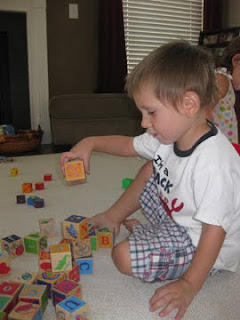
We played with our Alphabet Blocks
First we made a "castle."
Then, Marcus made a "train" out of his blocks by lining them up in a row. He needed to use every block to do this. It was a lo-0-ong train!
Stack and Sort:
We played with our Melissa & Doug Stack and Sort Board
Stamping:
We did some stamping
If you are doing this with a very young child (1 or 2), I suggest purchasing a larger washable stamp pad. The stamp pad that comes with the Melissa and Doug kid will work, but the larger one is easier.
Coloring with Crayons:
Sophia enjoyed scribbling and tasting her Jumbo Crayons
Reading:
And of course, we read many good books. This picture is very dear to my heart because it shows Sophia enjoying one of my favorite books from my childhood. My mama found all of my old books in storage and pulled them out for the kids. This was the story of little red riding hood. And Sophia kept pointing to the big, bad, wolf and saying..."wolf. bad." I love it that she is starting to string words and ideas together.
Stacking and Nesting:
We explored sizes while playing with our Alphabet Nesting and Stacking Blocks
Marcus liked to 'hide' behind his tower and then I would have to find him. This made me laugh quite a bit!
And of course, the best part of building a tower? Knocking it down!
Dramatic Play: When Pirates Come to Tea
As usual we have lots of unprompted, child led dramatic play over here. Marcus got out the Tea Set
Soon, Sophia joined our tea party. But, before she could come, she needed to put on the proper attire. Sophia loves to get into Marcus's drawers and pull out his red pajamas. I don't know why she is drawn to these particular pajamas, but she loves them. Every time we play in his room she likes to put them on. So, she insisted that I help her dress in the red, flannel pajamas for the tea party.
Sophia at the tea party:
Then, Sophia decided that she needed a hat to go with her outfit, so she grabbed the pirate hat and hook. And before you know it...we were having a pirate tea party and all talking like pirates! What fun!
Sophia also liked getting out her Dress-Up Dolls
Marcus then got out his Pirate Ship
Sensory Play: Goop, Water, and Sand
We hosted an outdoor "Goop Playgroup" at our house this week. Read about our entire adventure here.
We made goop:
We played in our water table and practiced pouring:
And we played in the sandbox and wading pool:
Nature Studies:
We also did two nature studies this week.
On Monday we explored a creek bed.
We also caught a frog and crawdad. You can read about that here.
And on another day, we went on a flower garden nature study. You can read about that adventure here.
Thank you very much for reading! And I would love to hear from you. So, please consider leaving a comment. Thanks again!
Cathy aka The Attached Mama
Subscribe to:
Posts (Atom)