One of the things I appreciate the most about the Montessori method is the idea of setting up a child's environment so that they can have a certain level of independence. I think that too often we under estimate the abilities of children. I also think that allowing children a certain level of independence helps boost their self esteem.
If you visit any Montessori classroom you will probably see some type of pouring activity in their practical life section. Students typically start our pouring with beans or other dry material and eventually move up to pouring with water. I decided to put all of this pouring practice to use in our house by setting up a drink station for the kids.
How this station came about:
For awhile, I felt like I was filling up sippy cups all day long. The kids would usually take a drink, set their cup down somewhere, lose it, and then ask for another sippy cup full of water. Between the two of them I was filling up cups every 20 minutes all day long---and then going through the house and collecting all of the lost cups so I could wash them. It was insanity. I decided that a big part of the problem was our whole sippy cup set up. Sippy cups don't require care. You can just throw them down anywhere without having to worry about them spilling. They almost invite the child to be careless with them. Another part of the problem was that we simply had too many cups. Lots of cups = lots of dishes! And finally, a huge part of the problem was that the children currently had no way of getting a drink for themselves.
So I set off to think of a way to make this possible for them to do. Some would call this neglectful parenting, I call it Montessori! ;)
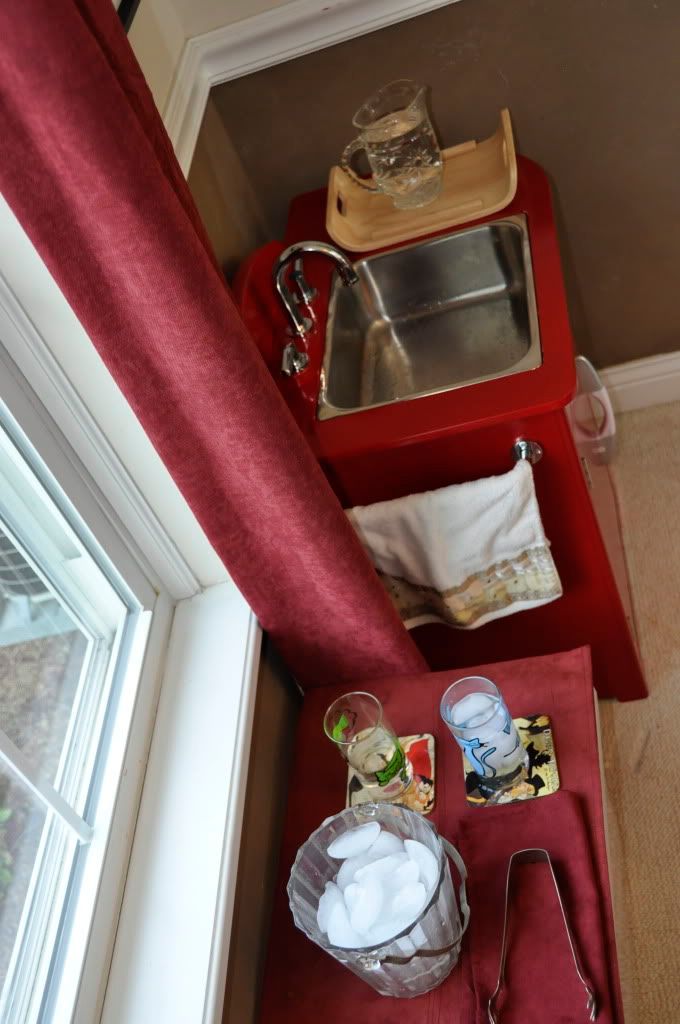
Here is where the kids are able to pour themselves a glass of water whenever they want. Every morning I set out clean glasses, fresh ice, and fresh water. The rest is up to them. So far they have loved it!

Here is a close up of the little side table I added to our sink.
 It took some tweaking to find a setup that allowed the kids to do this independently.
At first I tried storing all of this stuff next to the sink, but it was too hard for Sophia to reach around things without knocking over a cup. She needed more room, so I used a clear plastic bin as a side cart to give them some counter space. Even though it is just a plastic bin, I tried my best to dress it up and make everything look "pretty" and nice for the kids. That way they would know that these glasses are something to be taken care of. Not something you just throw on the floor.
One the side cart we have a glass for each child. (Marcus gets the blue glass, Sophia gets the green.) They also have an ice bucket, ice tongs, a coaster, and a napkin to store the tongs on.
 On the sink I am storing the pitcher of water that way they won't have to carry it anywhere.
 It took a little tweaking to find a process that they were able to do independently. What we finally found worked the best was to have the child fill their cup full of ice. (They LOVE using ice tongs by the way!!) Then place their glass in the metal sink and pour water using both hands on the pitcher. (The metal sink is able to catch any spills.) Then when they are finished, they know how to wipe up any spills and rehang the towel.
 To see what other Montessori inspired activities we have gotten into this past week, check our our weekly wrap up post here.
If you visit any Montessori classroom you will probably see some type of pouring activity in their practical life section. Students typically start our pouring with beans or other dry material and eventually move up to pouring with water. I decided to put all of this pouring practice to use in our house by setting up a drink station for the kids.
How this station came about:
For awhile, I felt like I was filling up sippy cups all day long. The kids would usually take a drink, set their cup down somewhere, lose it, and then ask for another sippy cup full of water. Between the two of them I was filling up cups every 20 minutes all day long---and then going through the house and collecting all of the lost cups so I could wash them. It was insanity. I decided that a big part of the problem was our whole sippy cup set up. Sippy cups don't require care. You can just throw them down anywhere without having to worry about them spilling. They almost invite the child to be careless with them. Another part of the problem was that we simply had too many cups. Lots of cups = lots of dishes! And finally, a huge part of the problem was that the children currently had no way of getting a drink for themselves.
So I set off to think of a way to make this possible for them to do. Some would call this neglectful parenting, I call it Montessori! ;)
Here is where the kids are able to pour themselves a glass of water whenever they want. Every morning I set out clean glasses, fresh ice, and fresh water. The rest is up to them. So far they have loved it!

Here is a close up of the little side table I added to our sink.

At first I tried storing all of this stuff next to the sink, but it was too hard for Sophia to reach around things without knocking over a cup. She needed more room, so I used a clear plastic bin as a side cart to give them some counter space. Even though it is just a plastic bin, I tried my best to dress it up and make everything look "pretty" and nice for the kids. That way they would know that these glasses are something to be taken care of. Not something you just throw on the floor.
One the side cart we have a glass for each child. (Marcus gets the blue glass, Sophia gets the green.) They also have an ice bucket, ice tongs, a coaster, and a napkin to store the tongs on.






 . This is a very popular toy in our house. The kids love to play restaurant and cut their food using the little wooden knives that comes with the tray.

 . This is another big hit over here. I highly recomend these puzzles. They are a great idea on making the standard wooden puzzle more interesting. the kids use a magnetic fishing pole to catch the sea creature shaped puzzle pieces. Then, in order to play again, they have to put all of the puzzle pieces back into place. This toy taught the kids the names of some new sea creatures and it is a great fine motor activity.


 by MaryAnn Kohl. (A fantastic book that I highly recommend!)


