Showing posts with label Geography. Show all posts
Thursday, January 5, 2012

Reading Around the World: Studying World Cultures & Geography with Litterature

This year one of our main themes has been an introduction to the great world we live in.  My goal was to gently introduce to the kids to some other cultures while at the same time teaching them some very basic world geography.   I have been using a combination of Sonlight and FIAR to teach this as well as a sprinkling of some of other great books.


This year we have been going through the Sonlight P4/5 program which gives preschoolers a great introduction to our world through the use of literature.  We are loving the program, and I highly recommend it.   We are also big fans of the Five in a Row (FIAR) books, so we have incorporated those into our day too.
                                                                                                                                                                                                           
The existing P4/5 schedule is great as is.  However, I have modified it slightly for our use, and I wanted to share how we are using the program.   What I have done is to pull out all of the wonderful world culture stories in the Sonlight P4/5 program and grouped them by geographic region.  This gives us time to fully immerse ourselves in the various cultures we are studying.  So instead of skipping all around the globe, we get to spend a few weeks completely devoted to one culture/region.  This gives us time to do all sorts of fun things together as a family.  We might prepare and taste some traditional foods from the part of the world we are studying.  Sometimes we might do a craft project together using inspiration from artists who live in that part of the world.  Or, at other times, we might take a few days to learn some phrases from the language spoken in that part of the world.  Basically---it gives us the time to really let all of those cultures sync in as we "read around the globe".  I have also found that organizing the stories this way allows my very young children to really grasp the differences in cultures and people groups that can be found around the world.  When we were jumping all around the globe, this didn't sync in as much. 


In case anyone else is interested in reading around the world, I wanted to share our list of stories.  You will notice that we have included a lot of other books besides those included in the Sonlight P4/5 program.  Many of them are used in the Five in a Row program (another favorite of mine)...others are just good books that you can check out from your library.

How to use this study:
1.  Read through the stories at your own pace.  Use the sheet provided as a checklist to track your progress.
2.  As you are reading, feel free to weave in some craft projects, music, language activities, recipes, or hands-on projects into your study.  Do this as you have the time or your children are interested.

A NOTE ON PACING:  Included in this list are 166 readings.  That may seem like a huge amount, but I have found that this is a good number to fill up a typical school year of 180 days.   I personally make it a goal to read about a story per day.  With holidays and other interruptions, this usually works out pretty well.  Some days we read more, some days less.  I always suggest reading as your children are interested and going at their own pace. 


Book List for this study:
Around the World in 80 Tales, by Saviour Pirotta, Illustrated by Richard Johnson
Usborne Stories from Around the World, Retold by Heather Amery, Illustrated by Linda Edwards *
The Lion Storyteller Bedtime Book, by Bob Hartman and Krisztina Kallai Nagy *
Antarctic Antics: A Book of Penguin Poems by Judy Sierra
New Toes for Tia by Larry Dinkins *
The Gods Must Be Angry by Sheila Miller and Ian Murray *
Stories from Africa, Written by SIM missionaries *
Very Last First Time, by Jan Andrews **
A New Coat for Anna, by Harriet Ziefert **
Papa Piccolo by Carol Tally **
Another Celebrated Dancing Bear by Gladys Scheffrin-Falk **
Grandfather’s Journey by Allen Say **
The Glorious Flight by Alice and Martin Provensen (France and English Channel) **
How to Make an Apple Pie and See the World by Marjorie Priceman **
Giraffe That Walked to Paris by Nancy Milton **
Mirette on the High Wire by Emily Arnold McCully **
A Pair of Red Clogs by Masako Matsuno **
Wee Gillis by Munro Leaf **
The Story of Ferdinand by Munro Leaf * **
The Story of Ping by Marjorie Flack *, **
The Clown of God by Tomie dePaola **
Mr. Gumpy’s Motor Car by John Burningham **


---
* A Sonlight book
** A FIAR Book

General World Geography Books to Use for Reference:
Global Art:  Activities, Projects, and Inventions from Around the World by MaryAnn Kohl-
This is a great book to own, but most libraries will also have a copy of this that you can check out.  There are lot of great projects that you can use at your discretion as you study the various cultures and countries.   The projects are all rated by degree of skill...and I have found that many of the lowest rated projects are very appropriate for four and five year old children.

Children Just Like Me:  A Unique Celebration of Children Around the World by Anabel Kindersley
This is a great book for showing traditional clothing that other children wear around the world.  This is also a fairly common book and most libraries will have a copy of this. 

A Child's Introduction to the World Geography, Cultures, and People - From the Grand Canyon to the Great Wall of China by Heather Alexander
I am a big fan of the "Child's Introduction" series of books.    So when a fellow sonligher recommended this book I was anxious to check it out.  Our library didn't have a copy of it, so I had to bite the bullet and purchase it.  I am glad I did.  This is a great reference book with tons of ideas to incorporate into your study of the world.  This book will really grow with the child and you will probably find you are using it for years to come. 

Also, try to get your hands on a nicely illustrated multi-cultural cookbook made just for kids.  I would suggest hitting your local library and searching for a book there.  There are many, many great versions of these types of books out there.   If that is not possible, here are some to consider:
Kids Around the World Cook!:  The Best Foods and Recipes from Many Lands by Arlette N. Braman
Around the World Cookbook by Abigail Johnson Dodge

Another good resource to check out is some traditional music from the culture you are reading about.   This is another resource that I would utilize the library for if at all possible.   I highly recommend the  
Putumayo Presents Series of world music CDs.  Another great resource is the Wee Sing Around the World CD.

 Another resource is the continent song. We started off our study by learning the 7 continents on the globe.  At first the kids just memorized the words to this song, however, eventually, they learned to start locating the continents on the globe.  After you get the continents down, make it a goal to learn the various oceans.


Friday, July 8, 2011

FIAR: Lentil by Robert McCloskey

Would you like to win a copy of this book?  See my latest giveaway here!


This week we "rowed" the book Lentil by Robert McCloskey.
In this story, a boy named Lentil wants to make music.  However, he can't sing and he can't even "pucker his lips" to whistle.  However, he discovers he has a special talent for playing the harmonica.  Lentil uses this talent to save the day when a calamity threatens the homecoming celebration for the leading citizen of Alto, Ohio.

Social Studies:  Geography
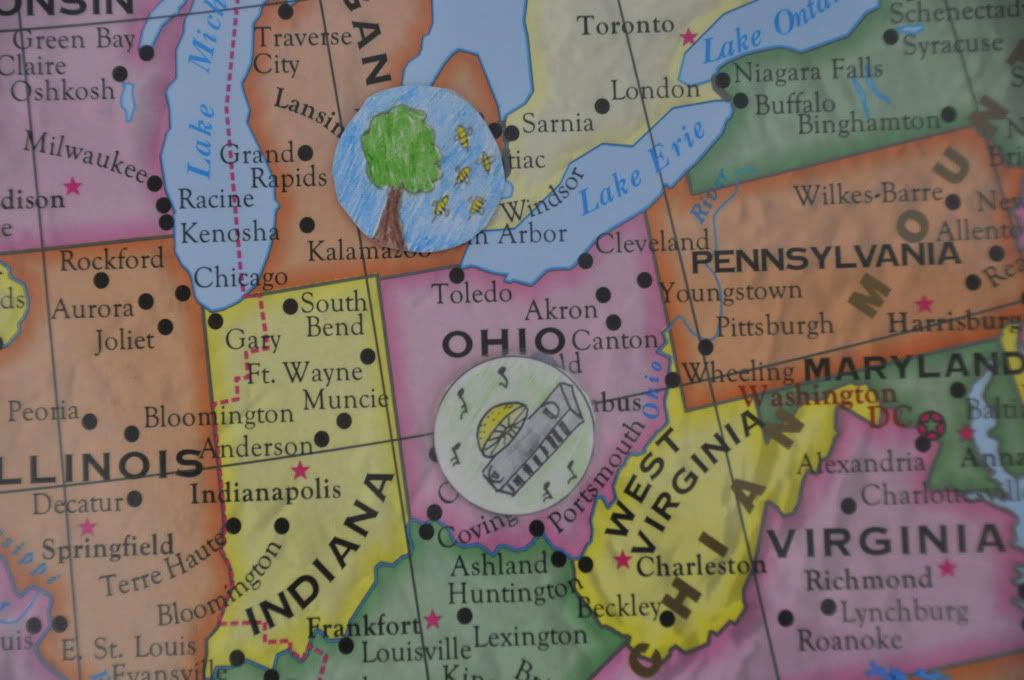
The story of Lentil takes place is a fictional small town in Ohio.  WELL...we happen to live in a small town in Ohio.  So this happens to be a setting that my children could very much relate to!  We placed a story disc for Lentil on our map for the state of Ohio.   Every day we would take the story disc off and review where it went on the map.
Our Lentil story disc on the map
Social Studies:  Human Relationships
In the story Lentil couldn't sing.  He can't even pucker his lips so even whistling is out of the question.  I asked Marcus and Sophie if they have ever been part of a group where others were doing something that they couldn't do.  Marcus remembered that at the swimming pool the other kids could hold their breath and jump into the water.  However, he was afraid to get his face wet, so he could only climb in slowly.  We talked about what it felt like to not be able to do something that everyone else could do.  We talked about how Lentil might have felt when everyone else could sing or whistle but he wasn't able to pucker.  However, Lentil wanted to make music, so he wasn't satisfied until he discovered that he could play the harmonica.  We talked about the importance of individual differences and discovering our own personal uniqueness.

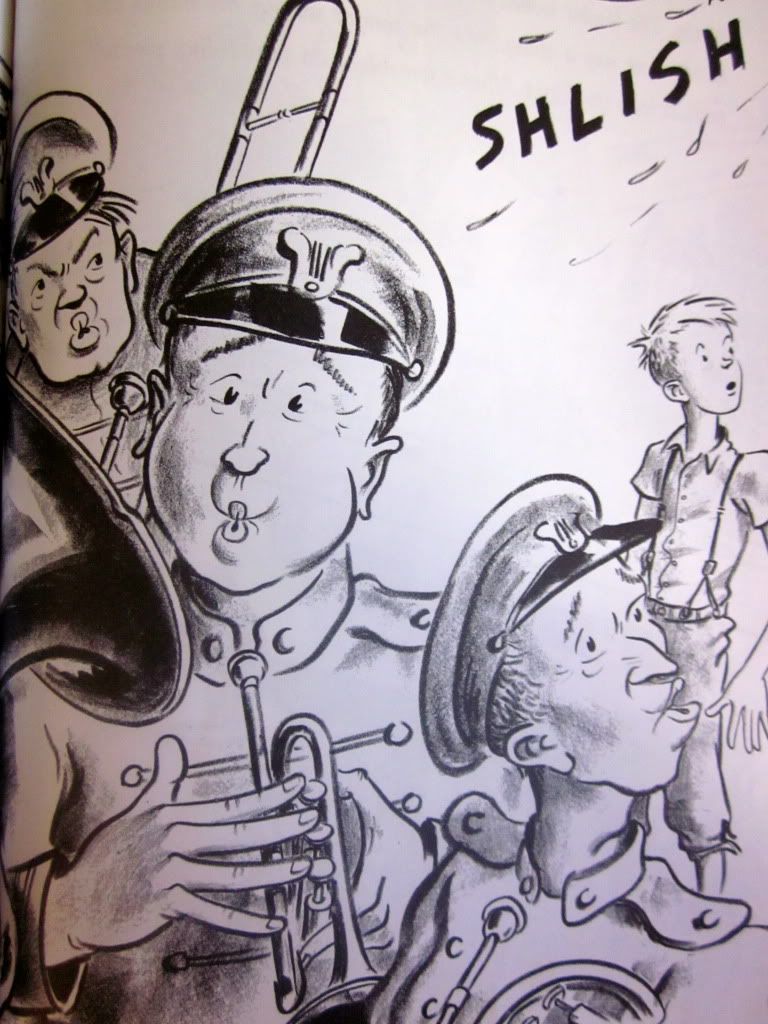
We also talked about how Lentil's weakness became an asset to him.  At the end of the story, Old Sneep is sucking on a Lemon which makes the entire Alto marching band pucker up so they can't play their instruments.  Since Lentil wasn't able to pucker, he was unaffected.  Lentil was able to still play his harmonica which allowed him to save the town celebration.
The entire marching band puckers up when they see Old Sneep sucking on a lemon.  This means they aren't able to play their instruments.

Social Studies:  Patriotism
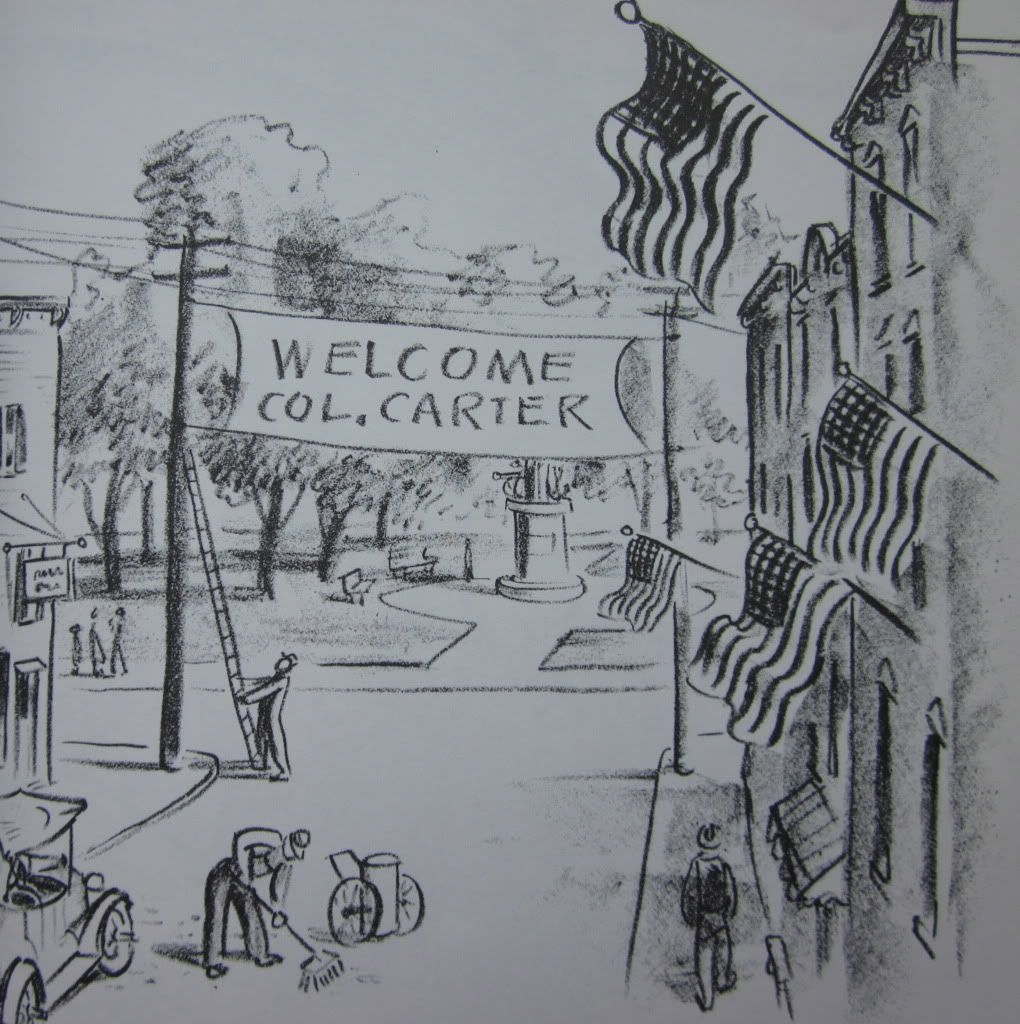
The town of Alto hangs flags all over their streets in honor of Colonel Carter's homecoming celebration.
The streets are decorated with the American Flag before Colonel Carter's arrival
I showed Marcus and Sophie the flag for the United States of America.  We talked a little bit about the symbolism of the flag.  We talked about how the stars represented each of the 50 states.  We also talked about how the stripes represented the original 13 colonies.

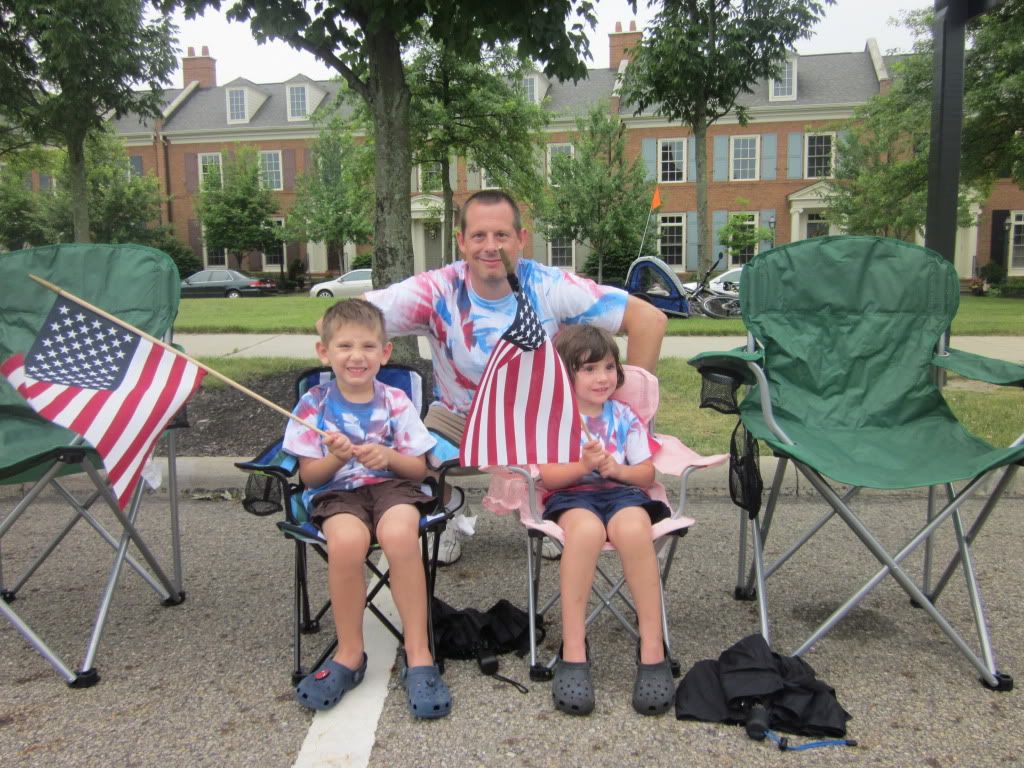
We also rowed this book during our town's Independence Day Celebration.  So we had a lot of opportunities to talk about Patriotism.  We decorated our house in the colors of our flag.  I sewed some homemade red, white, and blue pillows and table clothes with stars and stripes in them.  We also tied dyed red, white, and blue T-shirts.
The kids and their daddy in their homemade shirts wave their flags high in the air!

Later we also went and watched our Independence Day parade.  (Very similar to the one planned in the story!)  Our small Ohio town hung flags all over the streets in preparation of the big event.  We wore our patriotic shirts and waved our flag as the band and soldiers marched past.  This was also an excellent time to talk about flag etiquette.  We talked about how we could show our flag respect by never letting it touch the ground, dragging the flag, or stepping on it.  The kids took this responsibility very seriously as they waved their flags!
A Parade through a Small Town in Ohio

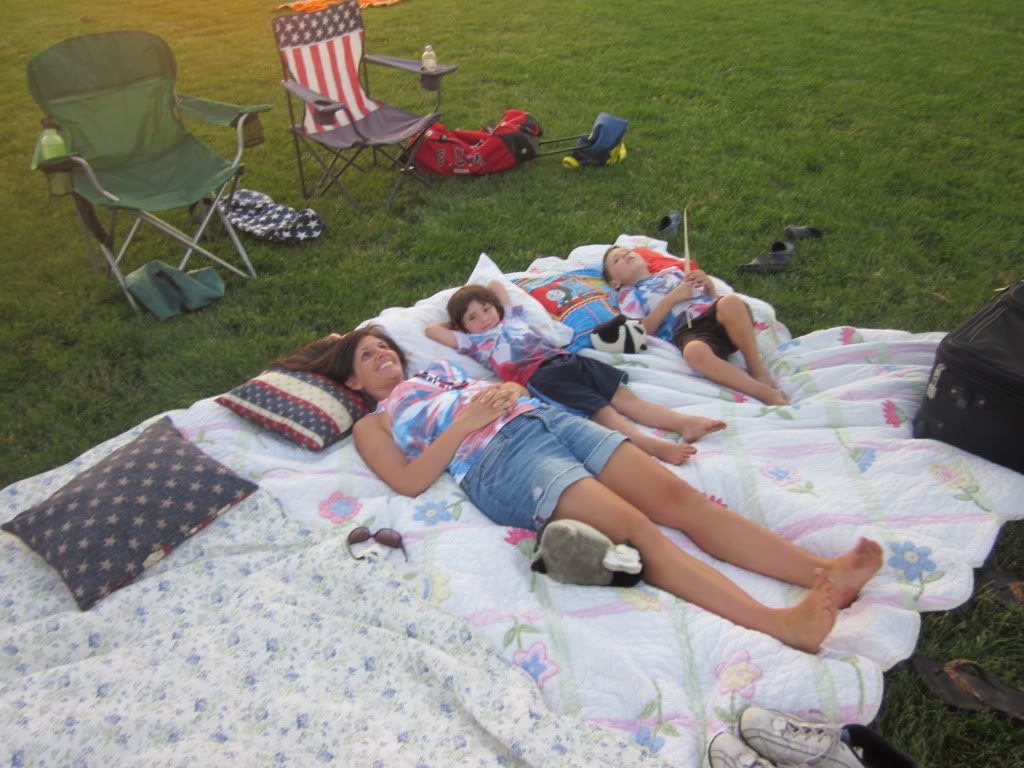
That night, we gathered together with the family to watch our towns firework display. 
Our view for the fireworks
Sophie and Marcus were finally old enough to even light a sparkler.  (They have been wanting to do this for years!)
Dad teaches the kids how to safely hold a sparkler
Math:  Patterns, Fine Motor Skills, and Art/Handicraft
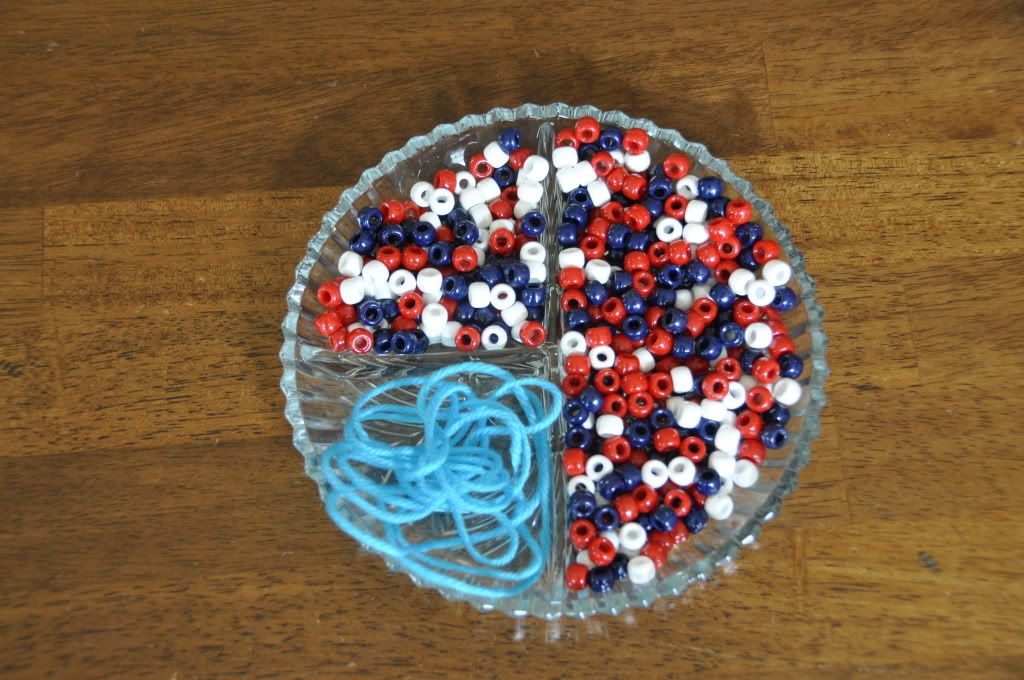
On another day we brought out our countries flag again.  We reviewed what colors were in our flag.  We also reviewed the symbolism of the stars and stripes by counting them again.    I also asked the kids if they saw any patterns in our flag.  Sophie noticed that the stripes went "Red, White, Red, White, Red, White..."  I then brought out some red, white, and blue pony beads and some tipped laces.  I practiced making a pattern and the kids would try to recognize and continue the pattern.  I then gave the kids the beads and they practiced stringing them in their own patterns.  Marcus made me a beautiful red, white, and blue necklace that I could wear to the fireworks.  It takes a lot of work for a 4 year old to string that many beads!  So it really touched my heart how much love he put into my necklace and how hard he worked out it!!
Necklace Craft Tot-Tray

Art:  Whittling as a Handicraft
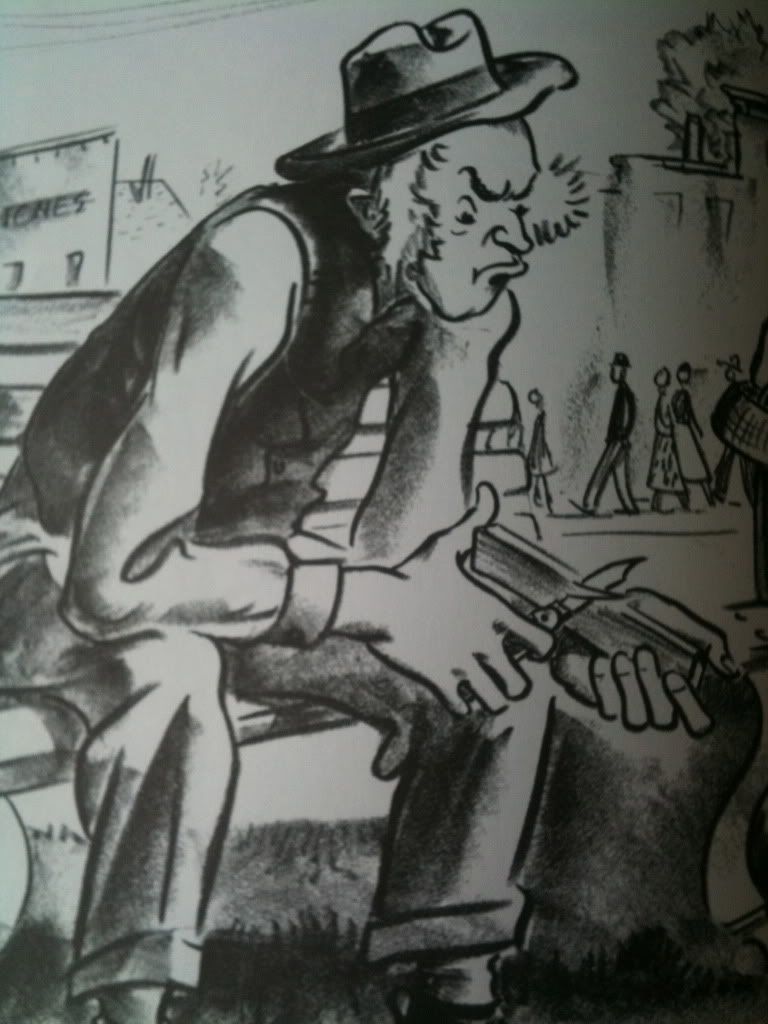
In the book, Old Sneep is jealous of Colonel Carter.  So while everyone else is planning for his homecoming celebration, Old Sneep just keeps "whittling and grumbling."
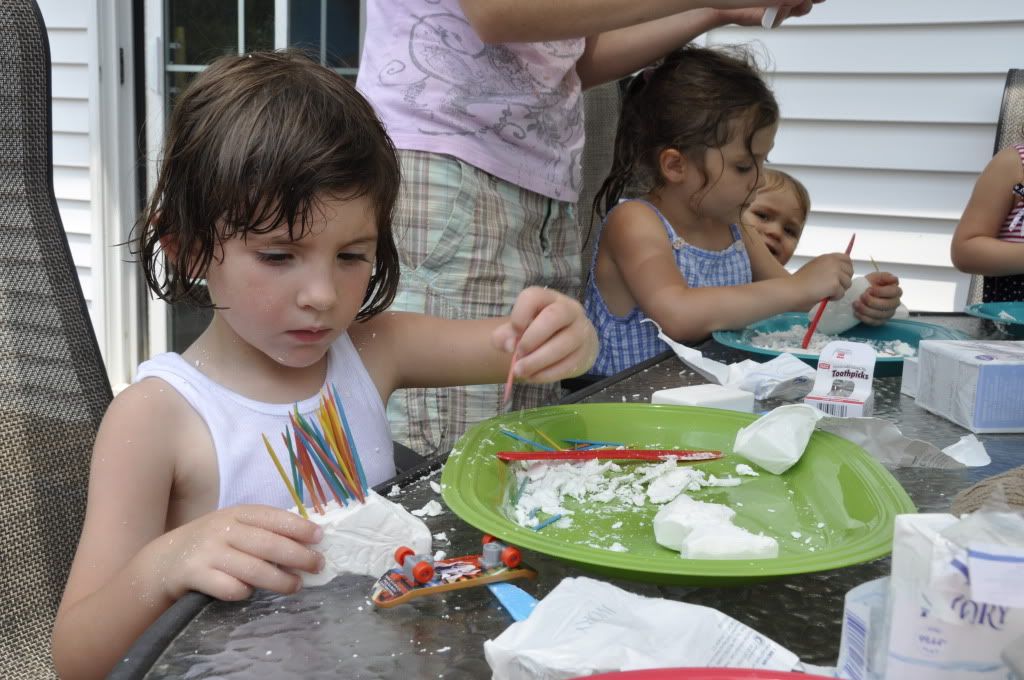
Whittling is where you carve an object by repeatedly cutting small slices from it.  Most young kids are probably not going to be familiar with what it means to whittle.  So, we decided to give the kids a chance to practice this craft on a bar of soap using a butter knife.
Sophie and her friends "whittling" soap.  (Sophie just finished running through the sprinkler.  She is a busy girl!)

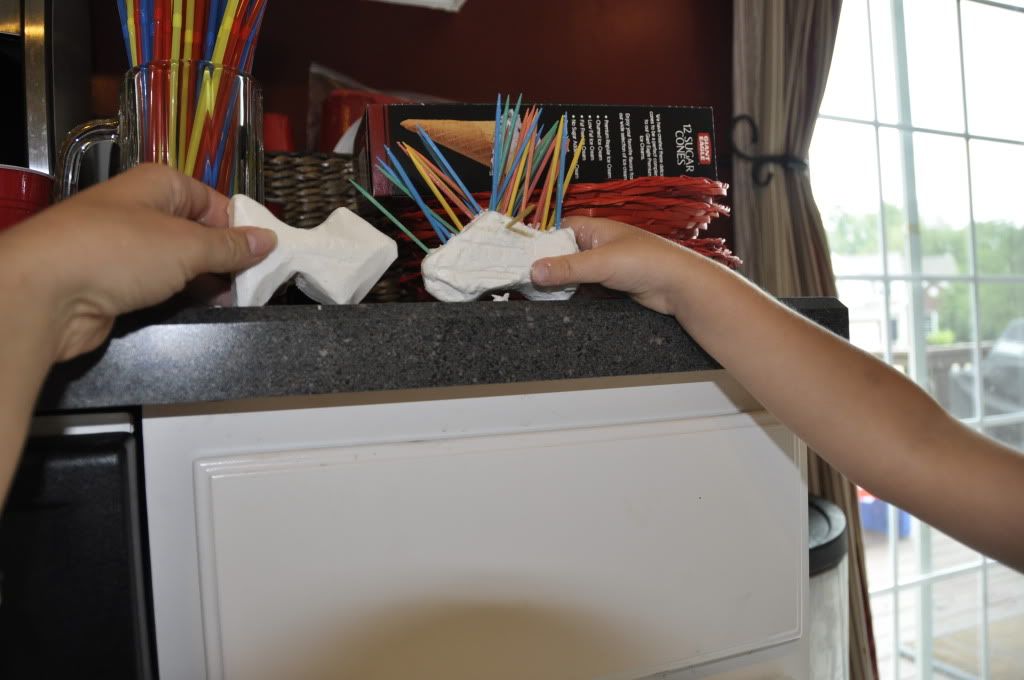
Sophie really got into this activity, she made several "sharks" out of soap and even stuck toothpicks into them.  I am not sure what the toothpicks were supposed to be on the shark!  However, she really got into giving her sharks spines.  I call it artistic license.
Sophie's Soap Sharks
Sensory Play:
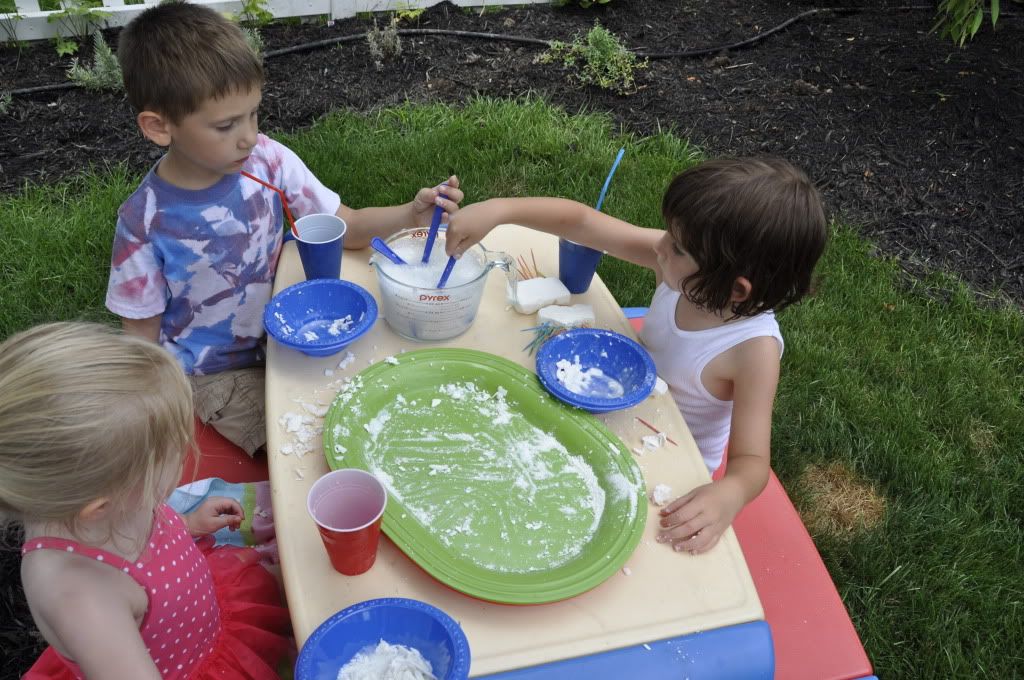
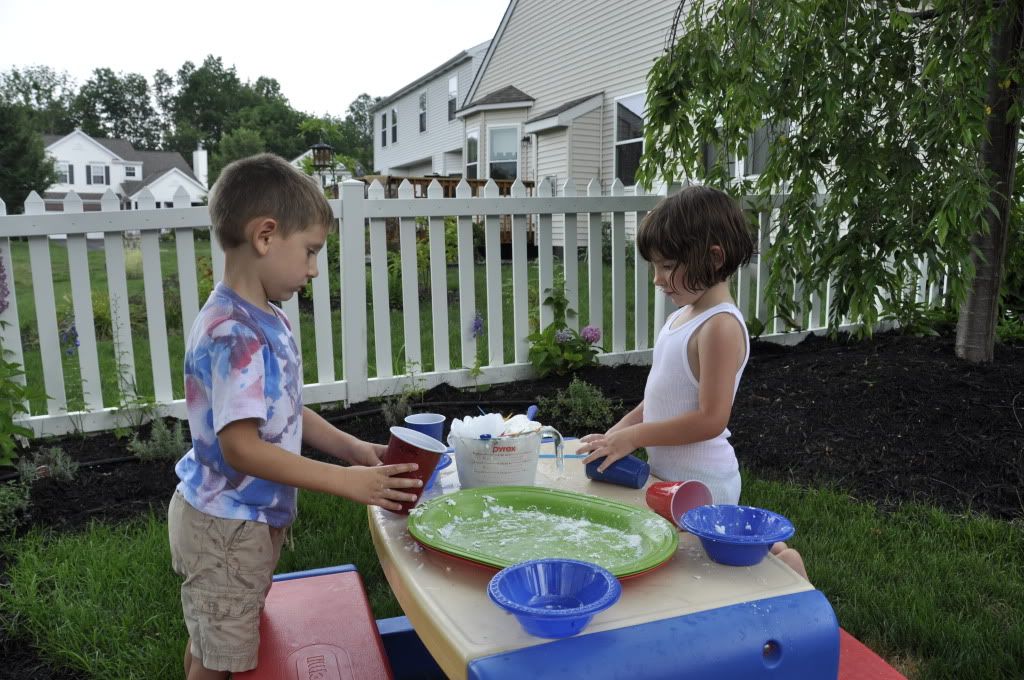
After having a large group of kids over whittling soap, we had a lot of soap shavings left over.  The other moms and I were tying think of what we could do with all of those shavings since it seemed like such a shame to throw them away.  Luckily, my friend is a former preschool teacher and full of great ideas.  She suggested that we set up a little sensory play with our soap.
Impromptu Soap Shaving Sensory Experiences
 We let the kids mix the shaving with bits of water and stir and move them around.  This created a lot of slippery and slimy fun for the kids.  You've got to love summer for fun experiences like this. 
Marcus decides to add some ice cubes to his soap concoction


Science:  Our Sense of Taste
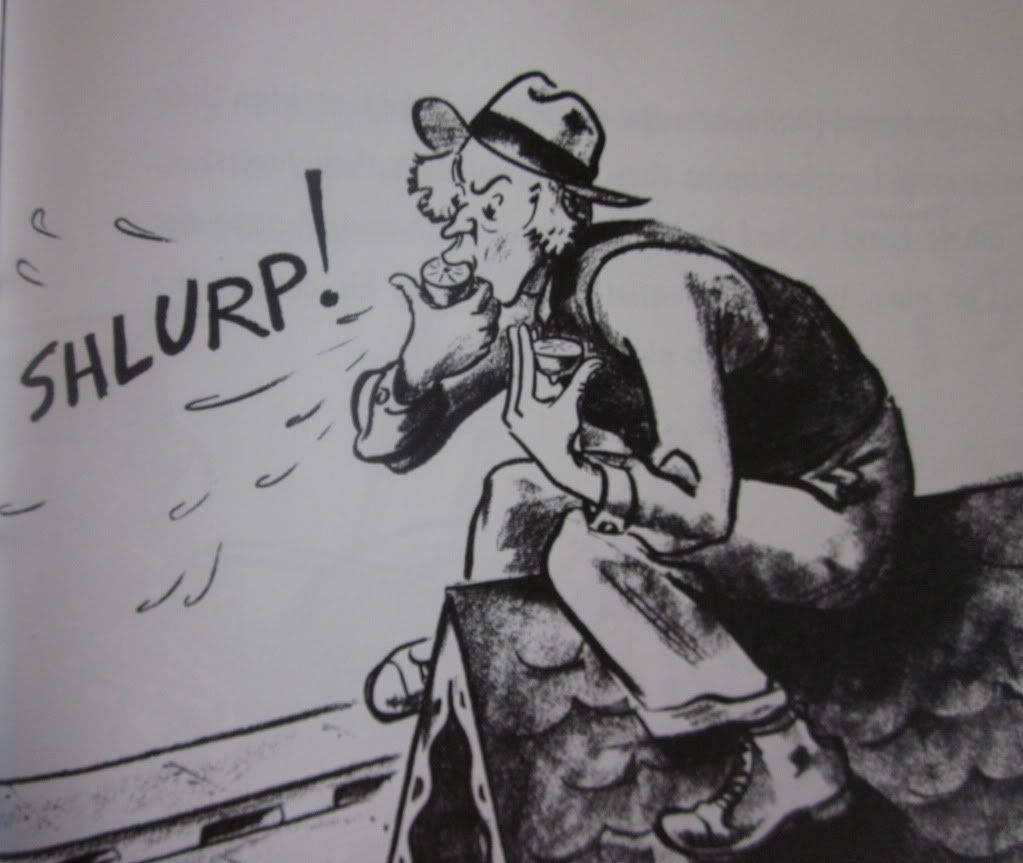
Old Sneep's plan for ruining Colonel Carter's celebration involves sucking on a lemon.
This causes the band members lips to pucker up so they can't play their instruments.  We used this as a springboard for a discussion on our taste buds.

Activity #1:  Tongue Tests
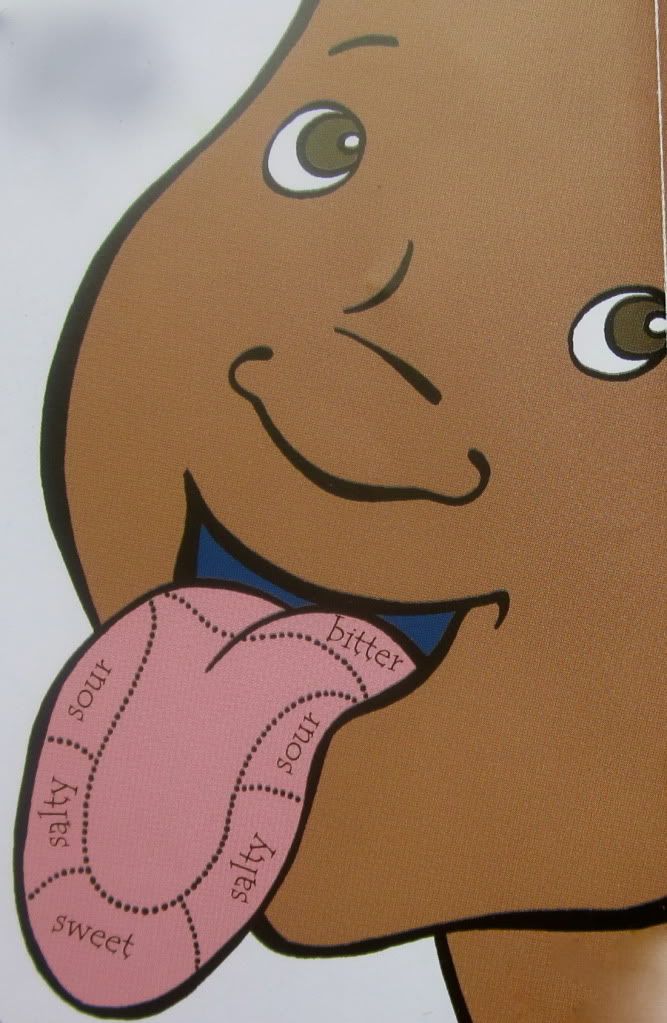
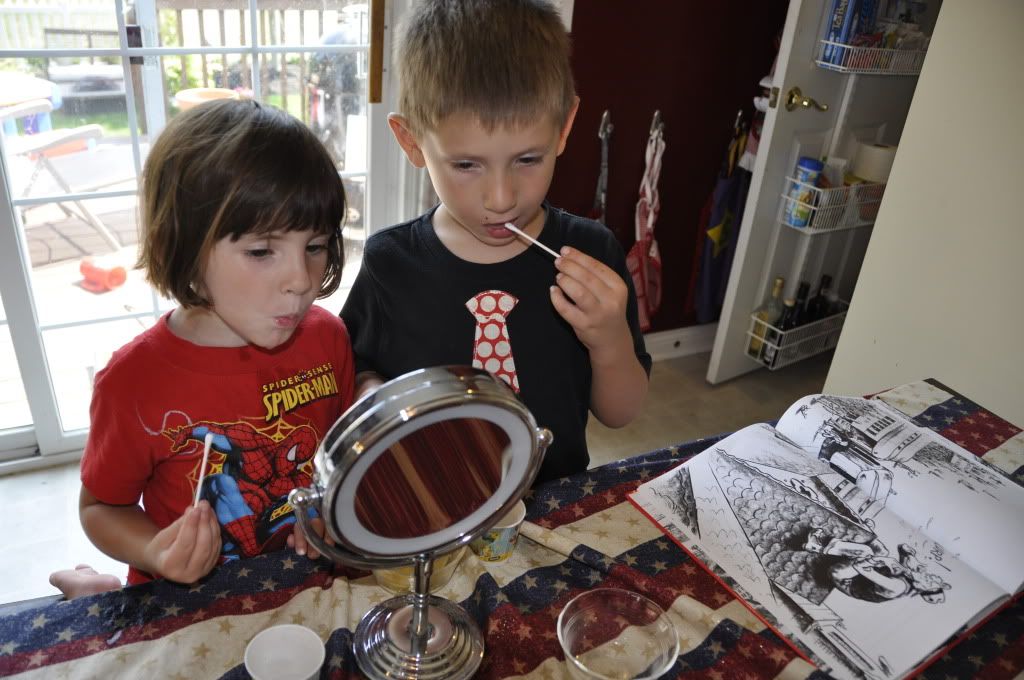
We talked about how we use our tongue to taste things.  We also discussed how different parts of our tongue can taste different things the best.  I had the kids stick out their tongues in front of a mirror and we looked at the small bumps on the surface of our tongue.  We also discussed which parts of our tongue taste different things.
This picture is from the Usborne Flip Flap Body Book.  This is one of the science books in our Sonlight P3/P4 curriculum. 
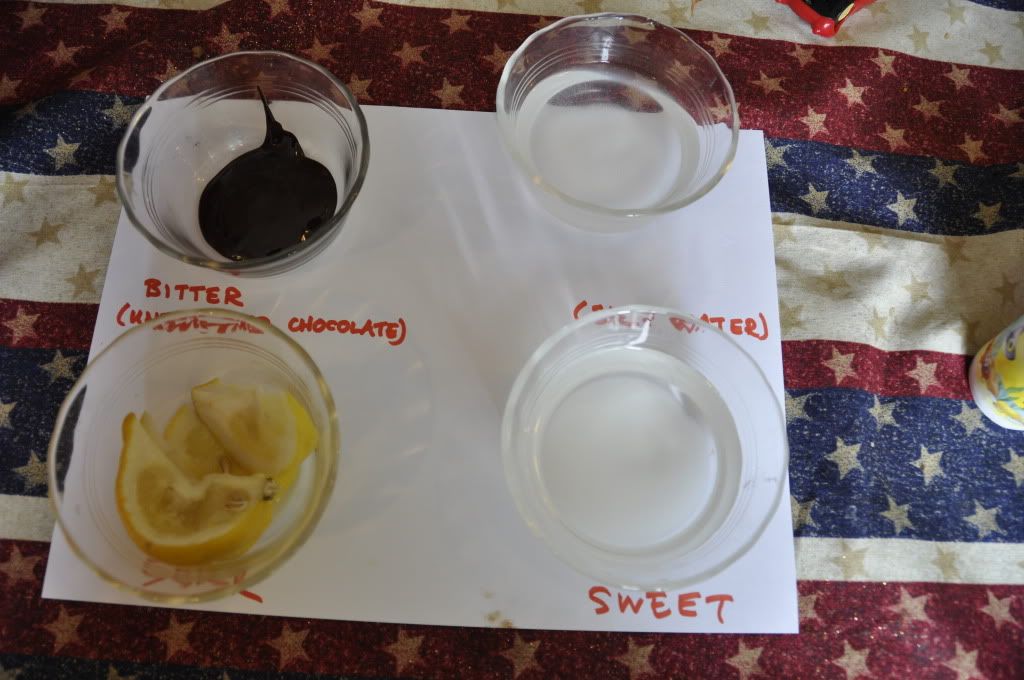
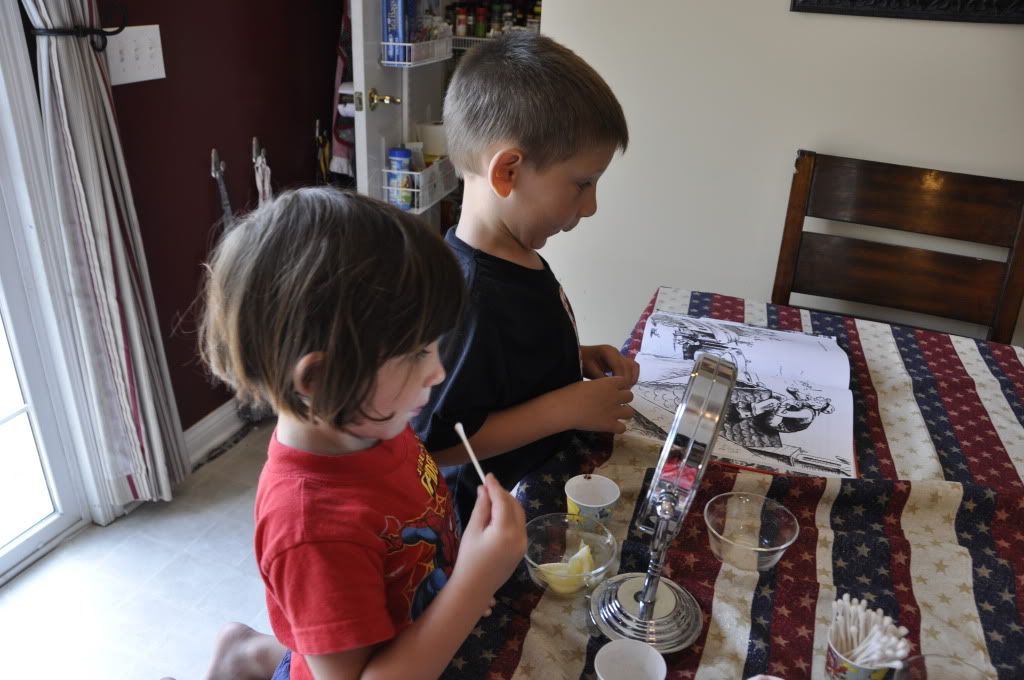
I then set out a series of substances for them to taste.  I gave them unsweetened chocolate for bitter, salt water for salty, lemon juice for sour, and sugar water for sweet.  This is important because most preschoolers are probably familiar with what sweet taste like.  However, most are probably not familiar with what sour, bitter, and salty tastes like.
Bitter, Salty, Sour, and Sweet Substances
 Then we did the following experiment to show how different parts of our tongue taste things differently:
1)  Dip a q-tip into the sugar water and dab it on the back of our tongues.  Then one side, and then the tip.  I asked the kids where it tasted the sweetest.  (Answer the tip of our tongue.)
2)  Next we rinsed our mouth with water and repeated the same process for the bitter, salty, and sour substances.
Marcus really did pucker his lips up after he tasted a sour lemon for the first time!  He looked just like an Alto band member!

Activity #2:  Smelling Tastes
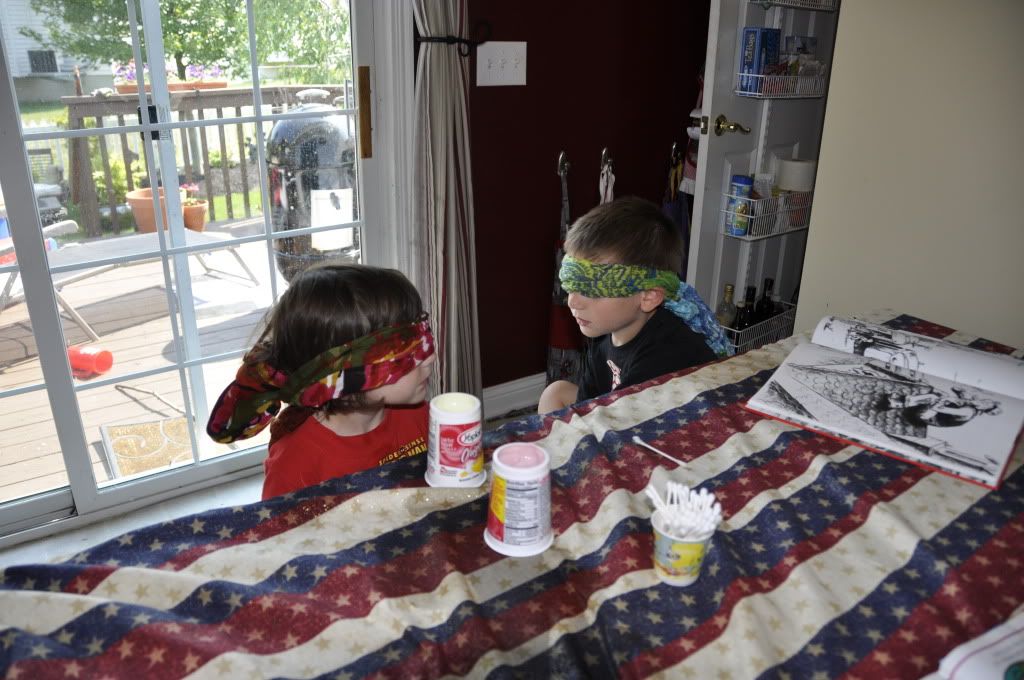
We then talked about how our foods can taste differently when we have a stuffed up nose.  So we talked about how our sense of smell plays an important part in our ability to distinguish between different tastes.  We did this experiment to show this:
1)  With a blindfold on, I had the kids taste cherry yogurt and banana yogurt.  I asked them if they could tell the difference?  (Answer yes.)
2)  Next, I had them pinch their nose and taste the yogurts again.  This time they couldn't tell a difference between the two yogurts.
We discussed how our tongue can only tell that both yogurts taste sweet.  It can not distinguish between the different flavors.  We use our sense of smell to disquisition between the different flavors.  That is why our food sometimes doesn't taste as good when we have a cold. 
The kids learning how our sense of smell plays an important part in our ability to distinguish between various flavors.
Science:  Sound and Acoustics
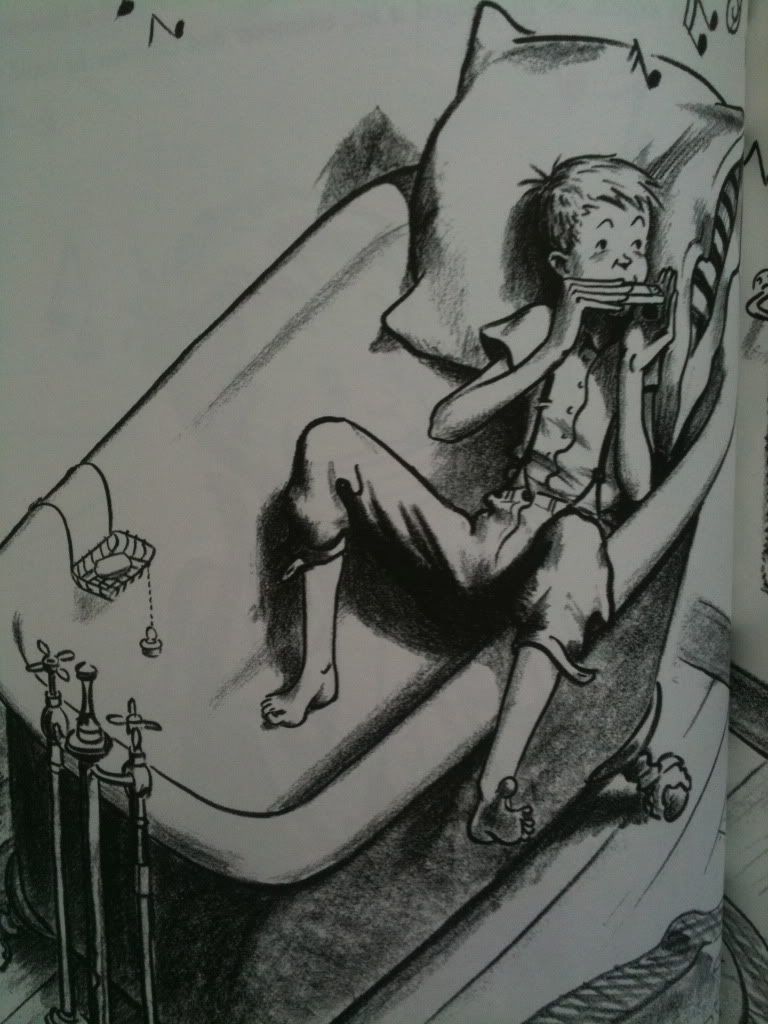
Lentil practices his harmonica in the bathtub.  He says, "There the sound is improved 100%."  So on another day we used this as a start for a discussion on sound and acoustics.


Activity #1:  Sound is made when something vibrates
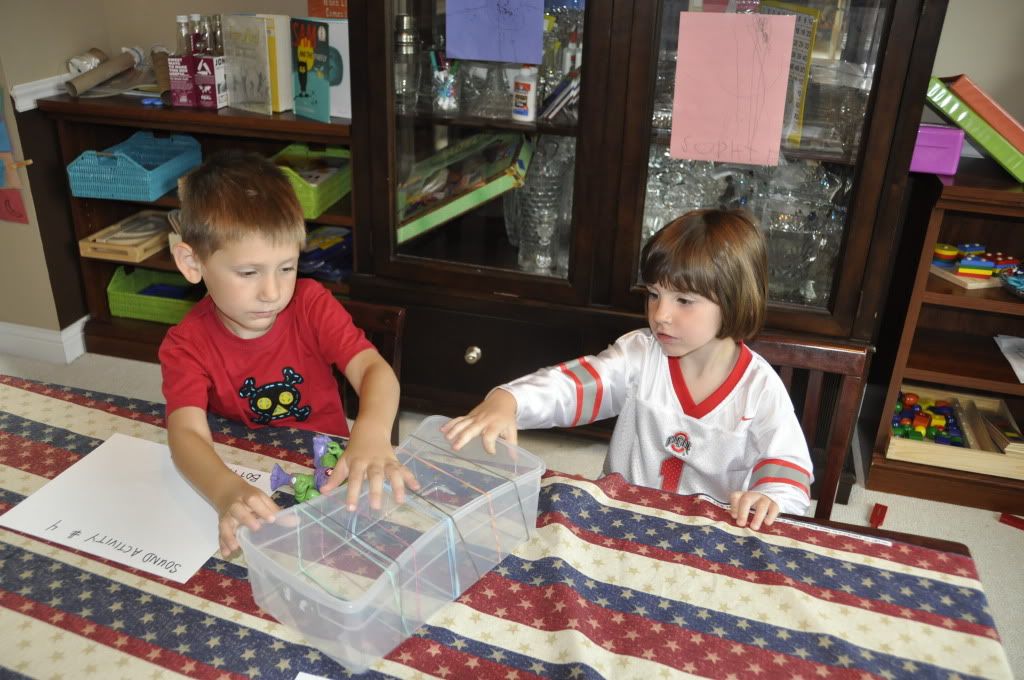
In our first activity, we stretched some rubber bands over a shoe box to make a "rubber band guitar."  I had the kids pluck the elastic to make a sound.  We noticed that the bands vibrate.  (I told them that vibrate means to move back and forth quickly.)  We talked about how sound is a form of traveling energy produced when something vibrates.

Activity #2:  How do we make sound?

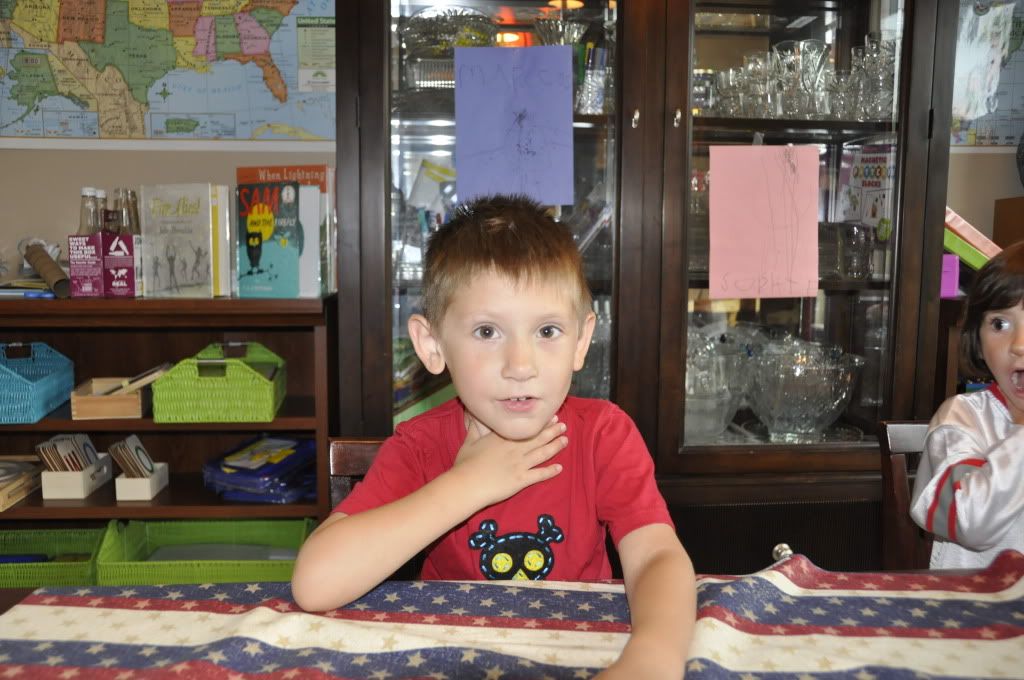
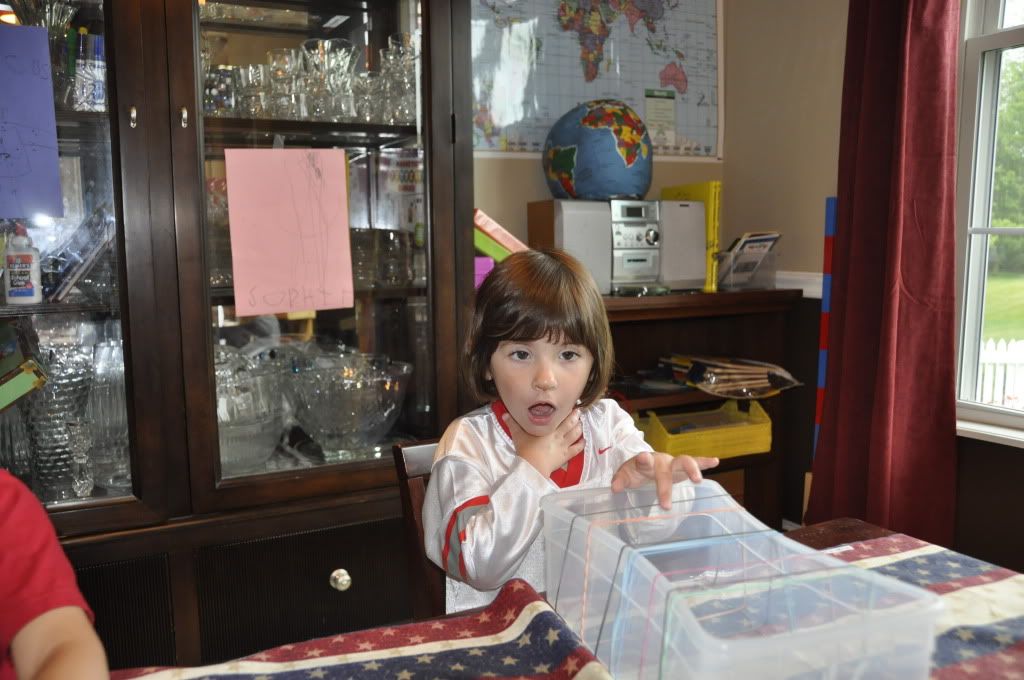
I had the kids put their fingers on the lump in the middle of their throat.  I then had them sing to see what it feels like.  They could feel their throat vibrating.  We talked about how you have parts in your throat called vocal chords which vibrate when we make sounds. 


Marcus and Sophie singing and feeling the vibration in their throats.
Activity #3:  Sound Catcher
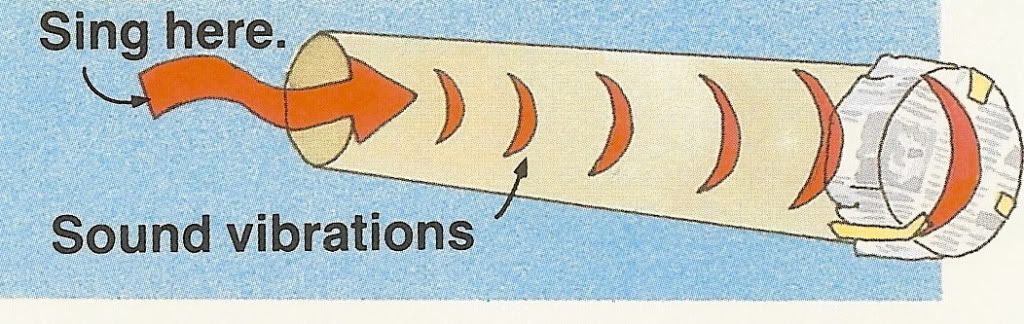
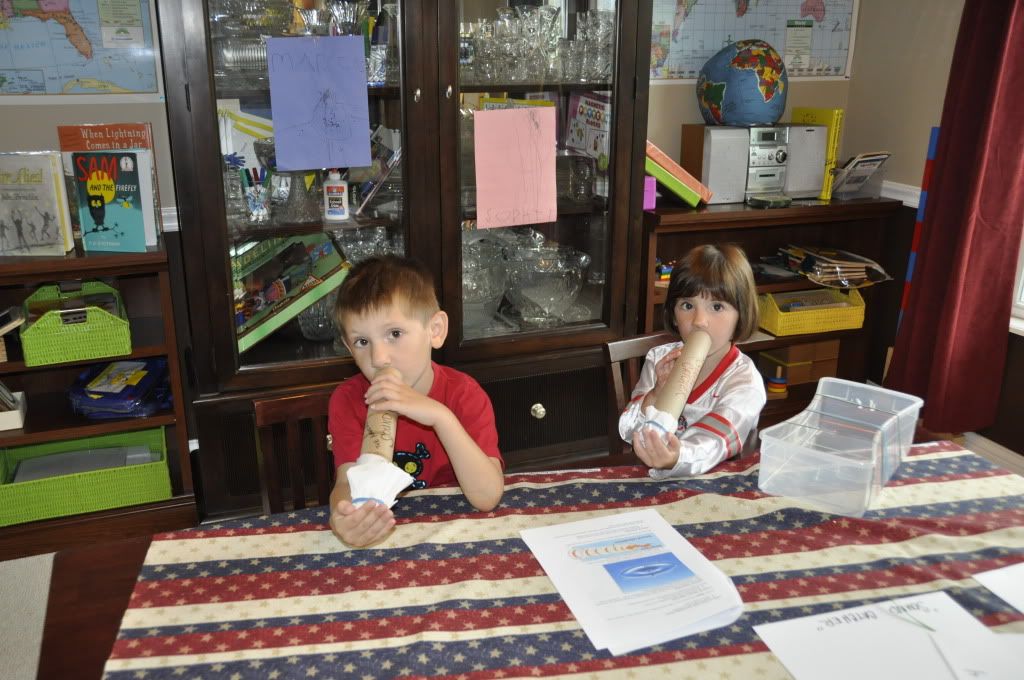
We talked about how sound waves travel through the air.  So, we made a "sound catcher" out of a paper towel roll with freezer paper taped to the end so that we could feel some of these sound waves.  (You have to get the paper pretty tight to get this to work.)  We sung through the paper towel rolls and we could feel the paper vibrating as our sound waves hit it.  We sang high notes which send very fast waves through the air.  This made the paper vibrate quickly.  Then we sang low notes which send slow waves through the air.  This made the paper vibrate slowly. 
"Sound Catchers" in Action

Activity #4:  Bottle Music
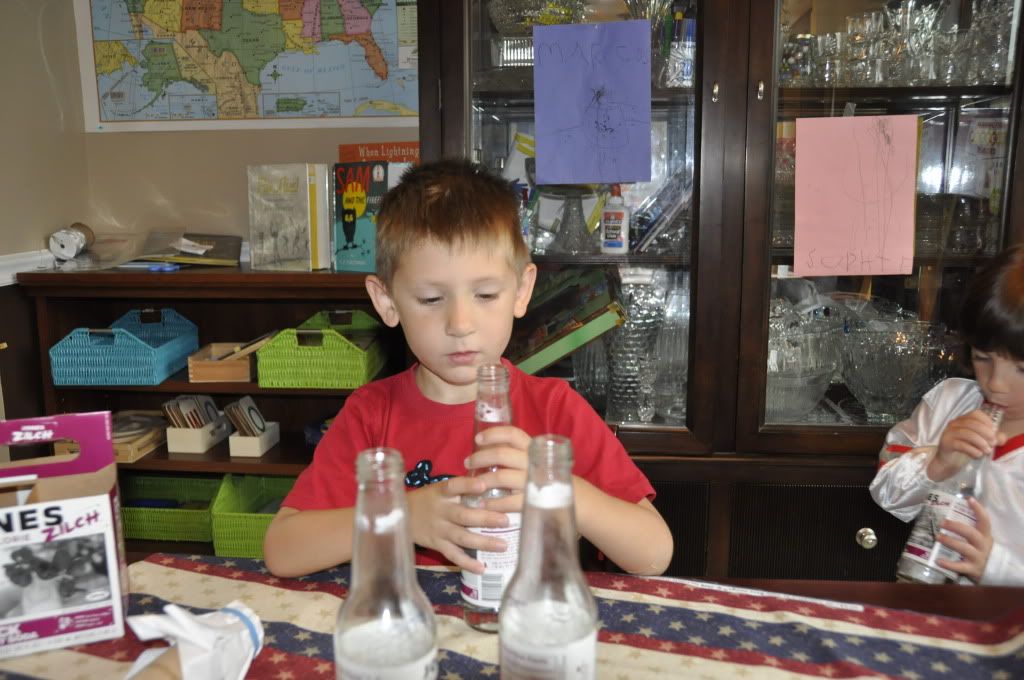
The next thing we did was blow across the top of an empty bottle to see if we could make a sound.  We then put a little bit of water into a bottle and blew across the top of it again.  We noticed that the sound changed.  I explained that the more water we put in, the less air was left in the bottle.  Smaller amounts of air vibrate more quickly and that made a higher sound. 
Learning about sound using some empty soda bottles
Activity #5:  How do we hear a sound? 
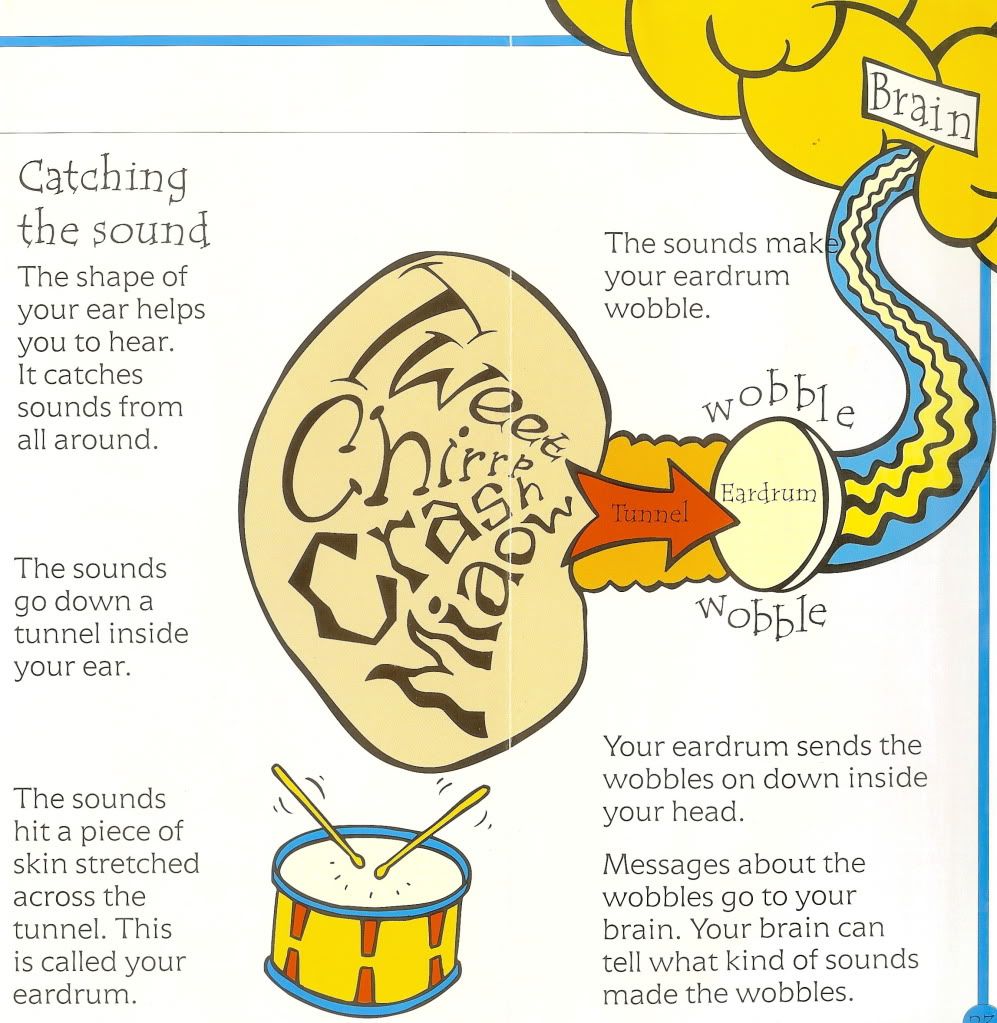
We talked about how the shape of our ears helps us to catch sound waves.  We then talked about how the sound goes down the tunnel in our ear and hits a special piece of skin stretched across the tunnel called an ear drum. 

We hit a drum to show them how the surface of the drum will vibrate when you hit it.  We talked about how our ear drum works in the same way.  When the sound waves hit it, it "wobbles".  We then talked about how our brain interprets messages about those "wobbles" and can tell what kind of sound we heard. 
We used this page from the Usborne Flip Flap Body Book to explain how our hearing works.
Activity #6:  How does a harmonica make sound?
We took out our harmonica and talked about how harmonicas are played by blowing air into the various holes.  I told them that the holes are also called reed chambers.  Each of these chambers has multiple, variable tuned reeds.  The reeds are secured at one end and loose on the other end.  When you blow into the holes it causes the loose end of the reed to vibrate and create a sound. 
Photo courtesy of Musicians Webstore
The kids were not familiar with what a reed was, so I showed them how a reed works using a piece of grass.  (Some people call this a grass horn.)  To make one of these find a piece of grass about 4" long and sandwich it between your thumbs stretching it tight.  (It takes some practice to hold it tight enough to make a sound.)  Then blow! 
Photo courtesy of WikiHow
Activity #7:  Why did Lentil's harmonica sound better in the bathtub?
In our next activity we talked about why Lentil's harmonica playing sounded so much better in his bathtub.    It improved the sound in two ways:  volume and reverberation. 

a) Volume:  Hard, smooth surfaces (like Lentil's bathtub) absorb very little sound.  The sound would reflect back and forth between the walls of the bathtub before eventually dying a way.  Since all of this sound energy was contained in such a small space, Lentil's bathtub boosts his harmonica's sound intensity. 

b)  Reverberation:  With many reflected sound waves bouncing around in the bathtub, some sound waves wind up traveling farther than others before finally arriving at your ear.  This stretches out the sound you hear, an effect called reverberation.  So when Lentil would play a note with his harmonica, the sound would seem to hang in the air long after each note is made.  This would result in a richer and fuller sound. 

To show this we did two different activities. 

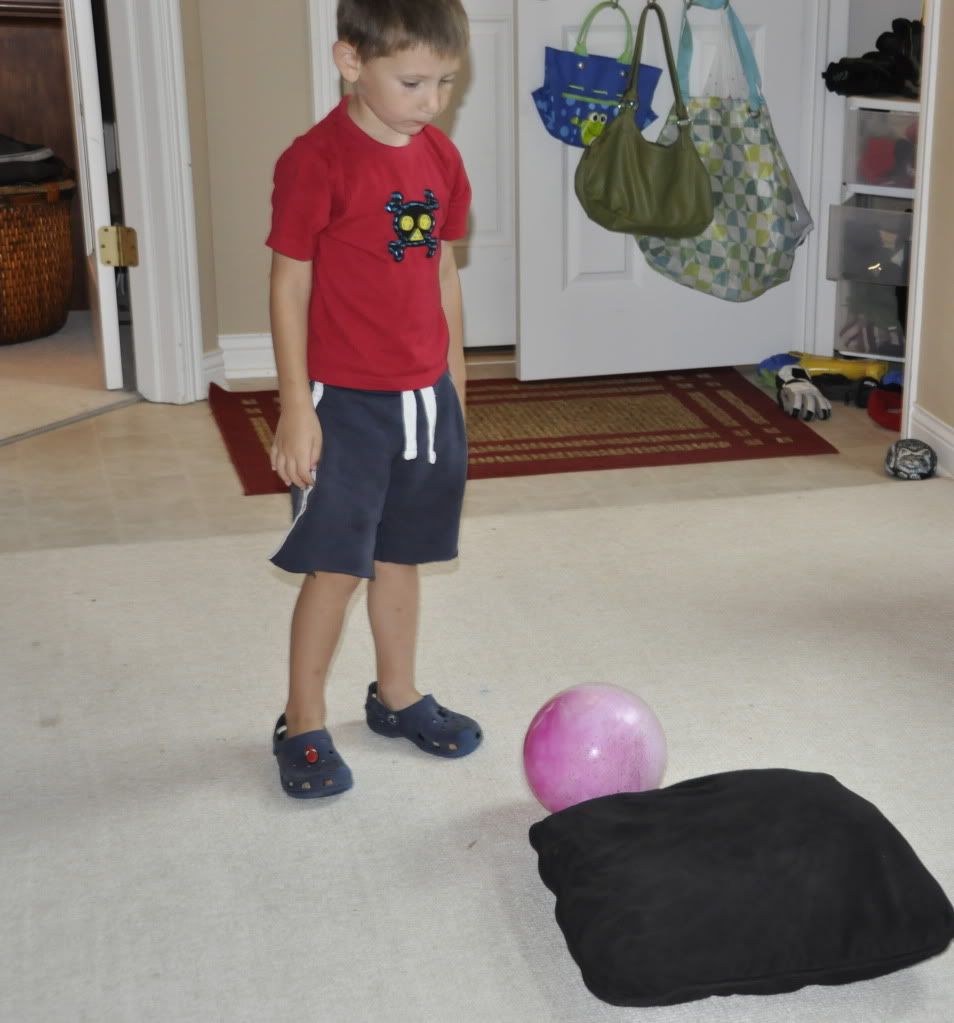
First we talked about absorption.  We talked about how soft surfaces can absorb forces.  Whereas hard surfaces can often reflect sounds.  Marcus and Sophie had trouble picturing what I was talking about so we used a ball to show this.  The ball didn't bounce when thrown on a cushion because the cushion absorbed the force.  The ball did bounce on hard surfaces. 
The ball will not bounce on a cushion.
The ball did bounce on hard surfaces.  Just like sound will.
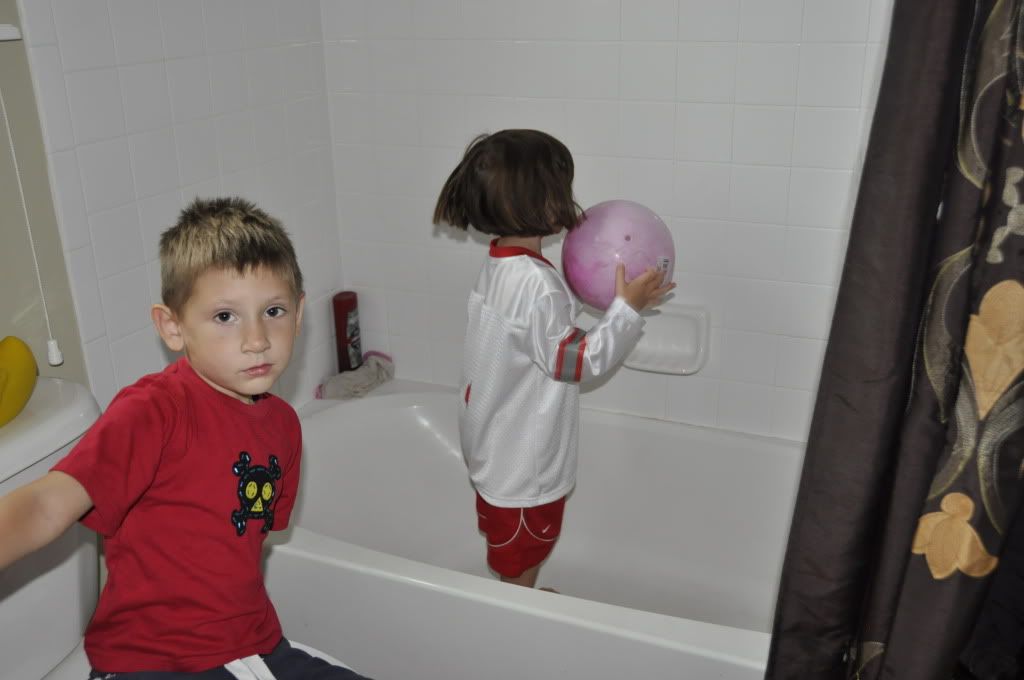
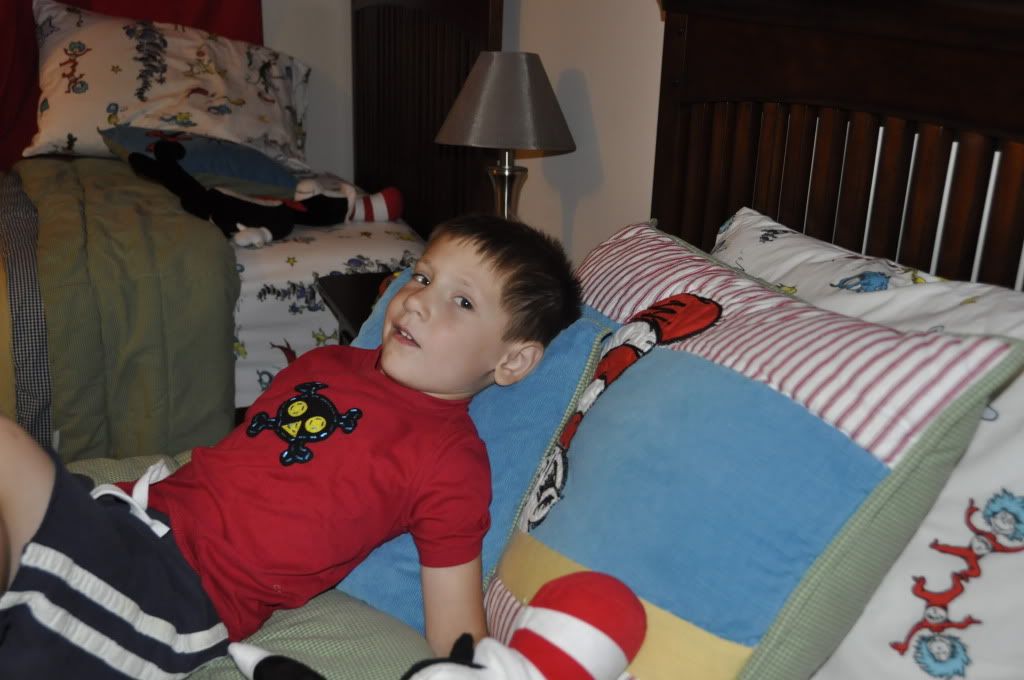
 Next we actually got inside the bathtub and tried singing.  We could hear the reverberation when we did this.  Next we got in our beds (with lots of soft surfaces) and tried singing.  We could hear the changes in volume and our sounds didn't sound as rich and full. 

Marcus singing in his bed. 


Making Memories:  Lentil Parade and Ice Cream Party
In the story, Lentil saves the day by playing "She'll be Comin' Round the Mountain" on his harmonica.  The entire town of Alto, Ohio marches to Colonel Carter's house while Lentil plays.  Then the entire town enjoys ice cream cones...and even Old Sneep is happy at the end.

At the end of the week we invited our friends over for a Lentil party.  Each kid wore red, white, and blue and brought a musical instrument.  We marched from our house to a nearby playground playing "She'll Be Comin' Round the Mountain when she comes".  We played on the playground  (aka the "train station")  for a bit and then came back to my house for ice cream cones.   It was a great time!

Our parade!  Kids are playing "She'll be coming around the mountain!"
Picture source:  Strader Speil  

We came back for Ice Cream and Lemonade after the parade
Picture source:  Strader Speil


Links to Become Attached To:
Soap Whittling Tips from Ivory
A WikiHow page on how to make a grass horn.
Preschool Corner (See what others are doing this week!)
Math Mondays- See other ideas for exploring math concepts with children
Tot School-  Tons of ideas for learning at home with your tot

Would you like to win a copy of this book?  See my latest giveaway here!
Tuesday, June 21, 2011

FIAR: Mike Mulligan and His Steam Shovel


Note:  I know that this post is rather lengthy.   However, instead of dividing it into separate posts, I wanted to put everything we did with this book in one place so it was easy for people to find at a later date.   My intent was not to overwhelm anyone with its length.  My hope is that you will find some ideas and inspiration here for your own Mike Mulligan journey. 
This week we "rowed" the book Mike Mulligan and his Steam Shovel by Virginia Lee Burton. 
 Introducing the Book: 
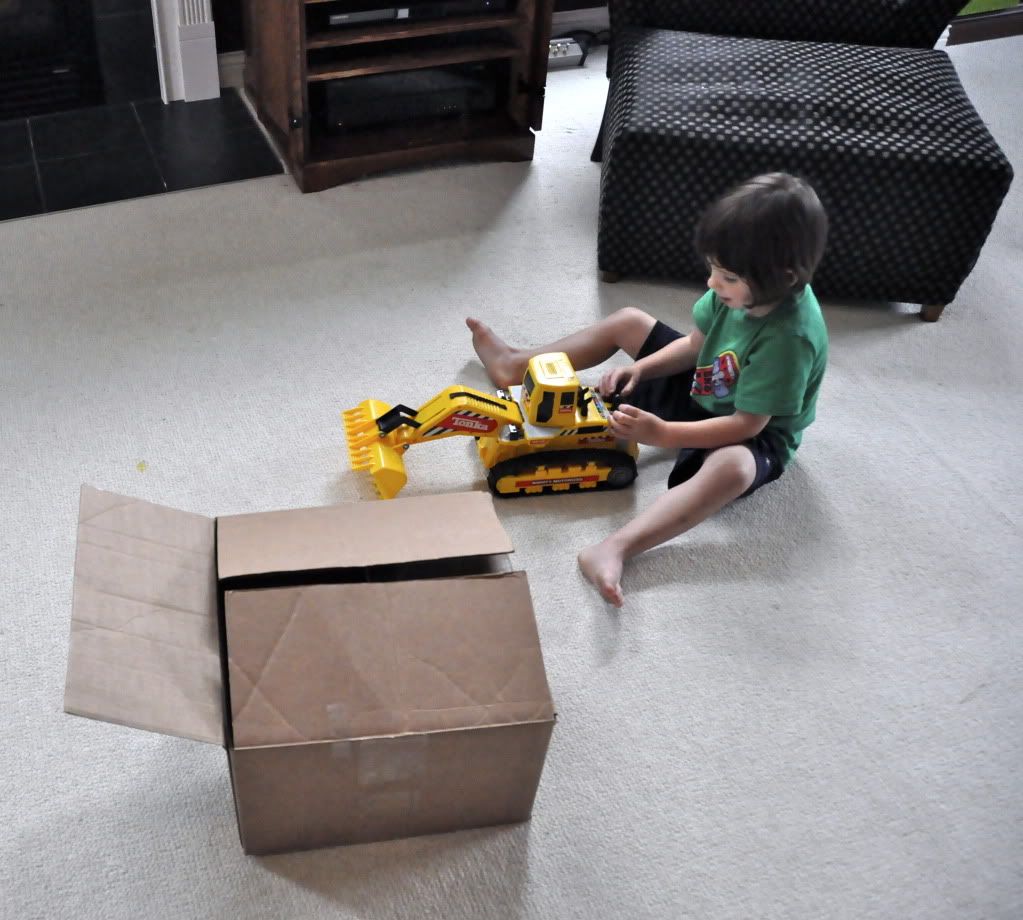
One of my goals with Five in a Row is to help create some fun memories tied to great literature.  So to make things fun, I had them guess what book we were going to "row" this week.  As a hint I wrapped up a toy excavator in a box and had them open it.  This was something I picked up at the thrift store awhile back. 
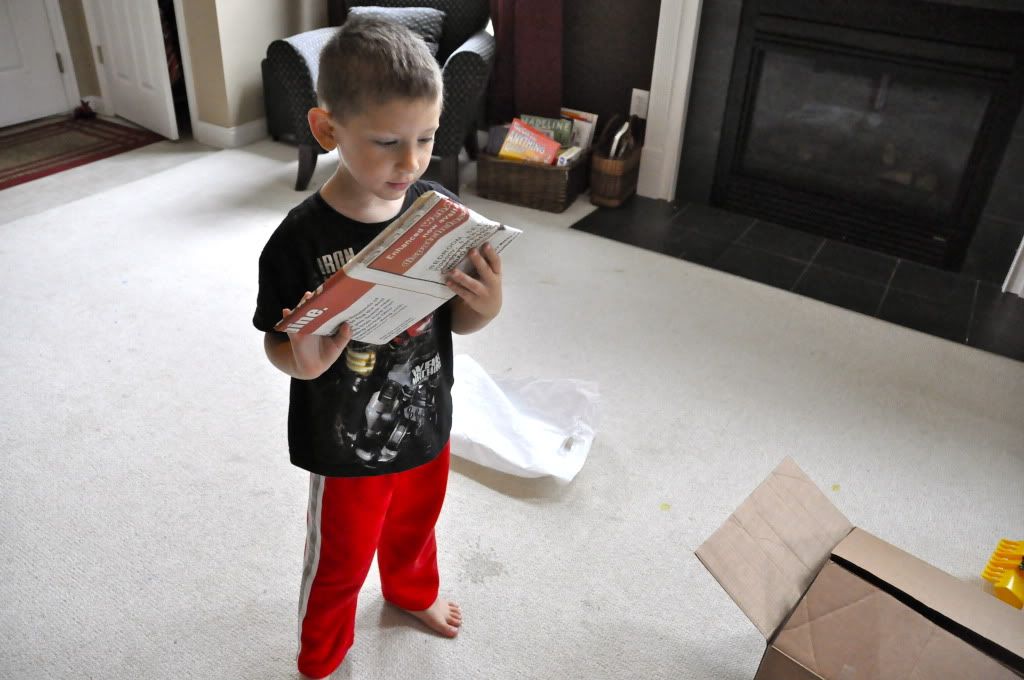
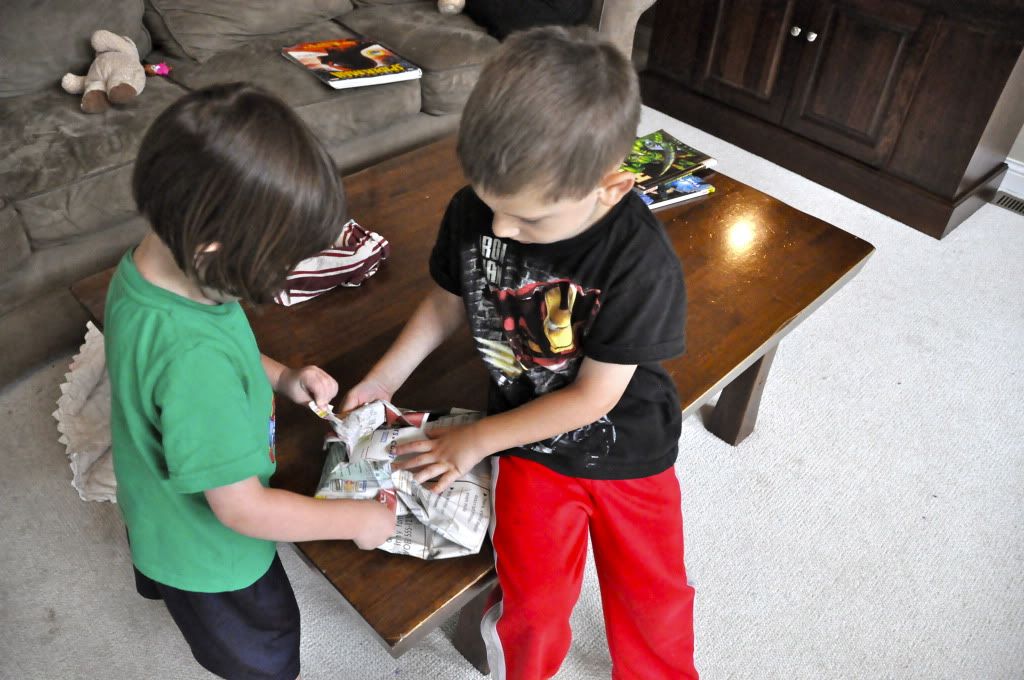
When they couldn't guess what the book was, I had them unwrap the book.  (I had the book wrapped up in newspaper like a present.) 
 I liked the anticipation this created for our week long theme with the book.  I am going to try to do this every week as time allows.
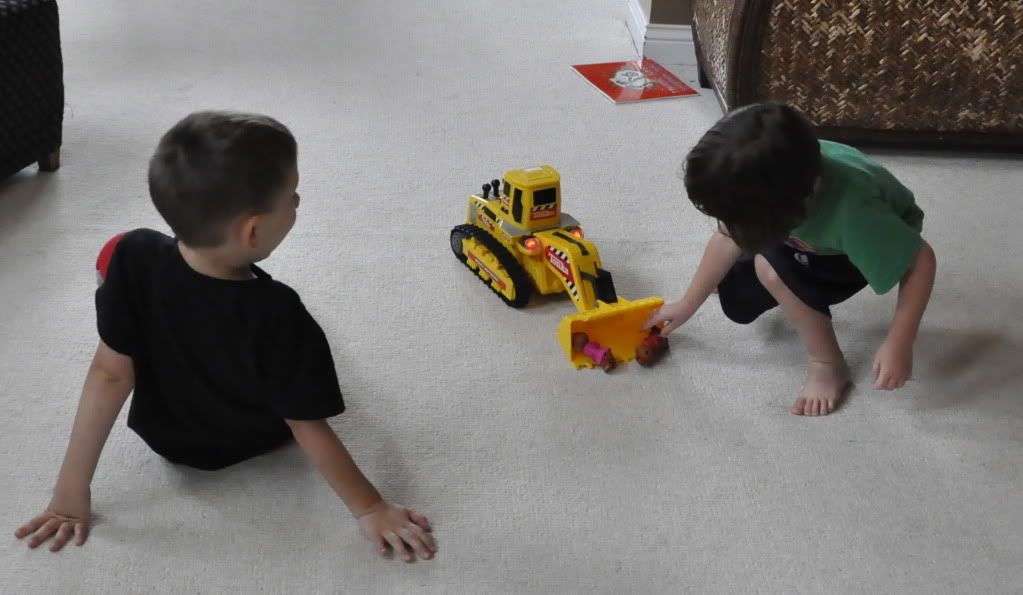
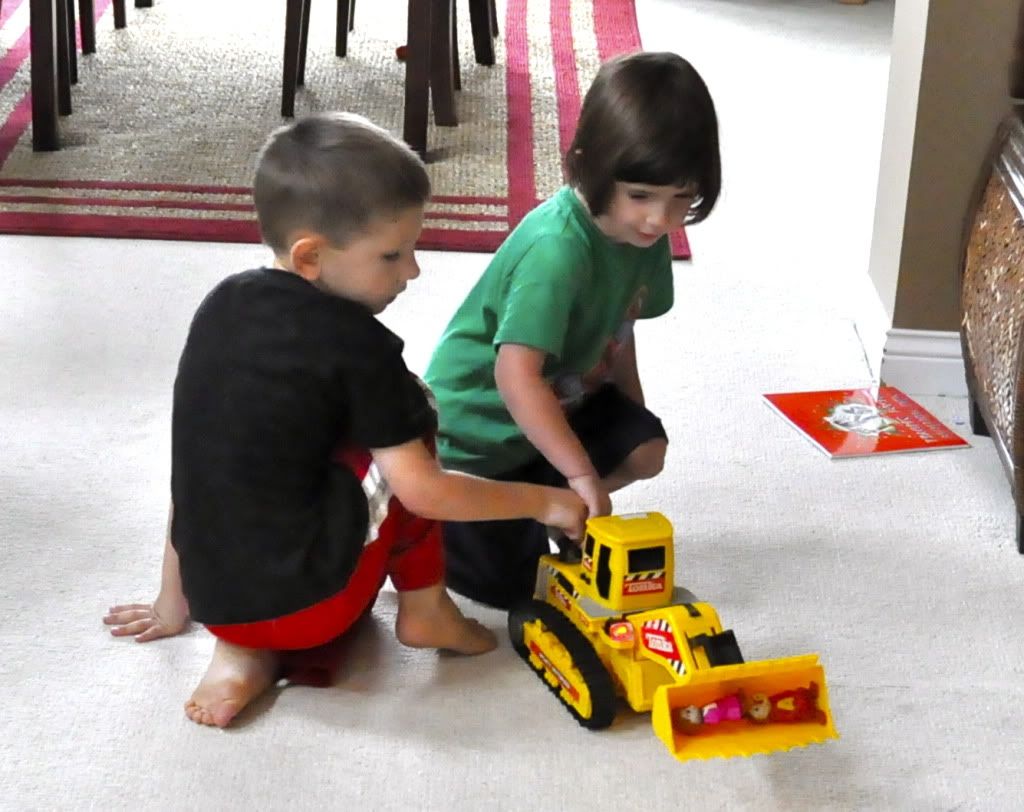
After we read the book for the first time, the kids spent some time trying to work the levers that control our own "steam shovel".  I know, I know it is not really a steam shovel.  But try to use your imagination!  :)  They used their steam shovel to scoop up their chipmunk toys and move them across the room.
 

Science-States of Matter and The Water Cycle:   
You can't exactly read a book about a steam shovel if you don't understand what steam is.  So we spent a few days this week talking about the states of matter which led us to a nice discussion about the water cycle.

To learn the states of mater, we took an ice cube and talked about how it was a solid.  We then let the ice cube melt turning it to a liquid.  We then heated the water in a pan and watched it turn into a gas.  After that, we classified various things as a solid, liquid, or gas.   (I did this just by quizzing them while they were in the backseat and I was driving.  Remember, science doesn't have to be fancy!) 

After that, we read the book  A Drop Goes Plop by Sam Godwin. This book does a wonderful job of explaining the water cycle in a way that even very young scientist can understand.  The book is also pretty funny.  I enjoyed reading the dialog between the mommy seal gull and the baby sea gull. 
Drop Goes Plop (Little Bees)


After reading this book, the kids watched The Magic School Bus Wet All Over.  (It is one of three shows on the The Magic School Bus: Catches a Wave DVD.   It is also available as a standalone VHS if you have a player.)   We learned some new vocabulary words including evaporate and condense.  I am a big fan of the Magic School Bus series.  I think it does a great job of explaining science topics in an entertaining way.
The Magic School Bus: Catches a Wave


After we watched the movie, we did a couple of very simple science experiments to re-enforce what we learned.  The science experiments came from the The Usborne Book of Science Activities, Volume One, pages 10-11.   This is one of our books from Sonlight, and I have to say that this is a FANTASTIC science resource to have in your home.  The Usborne books are very nicely illustrated and do a great job of describing concepts to visual learners.  The experiments are also very clever and can usually be done with things that you have around the house. 
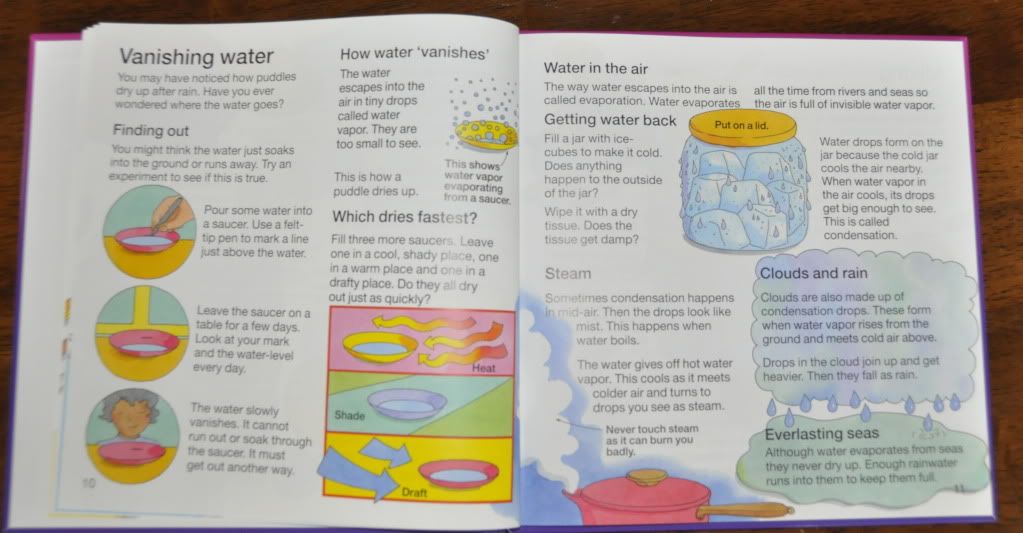
The Usborne Book of Science Activities is wonderfully illustrated and contains simple experiments that you can do at home.  These page explained the water cycle to the children. 
Science-  The Power of Steam:
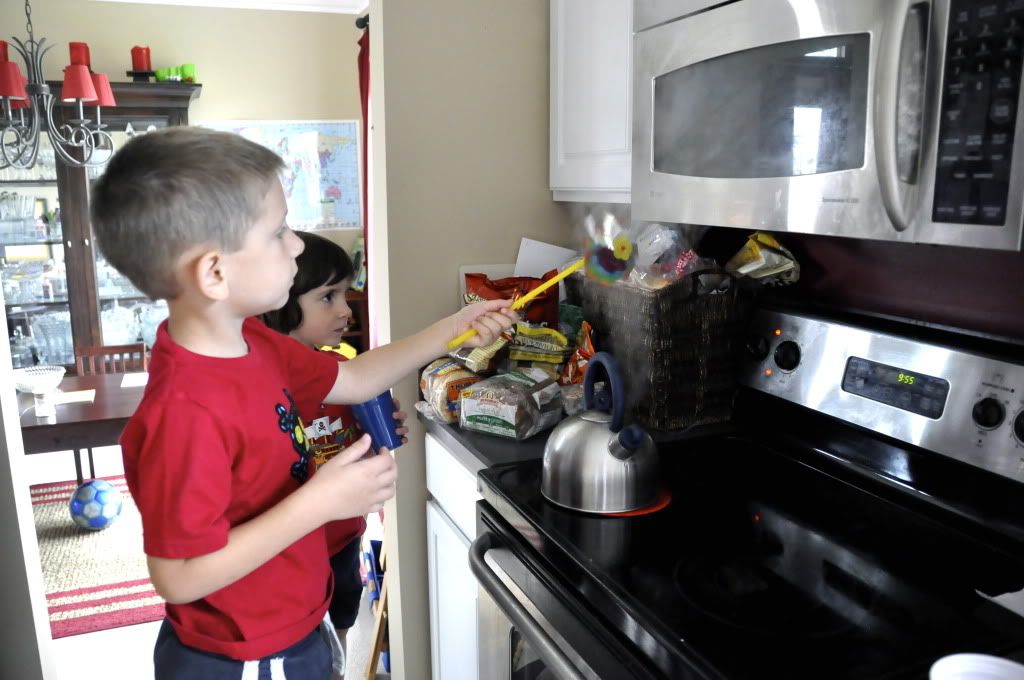
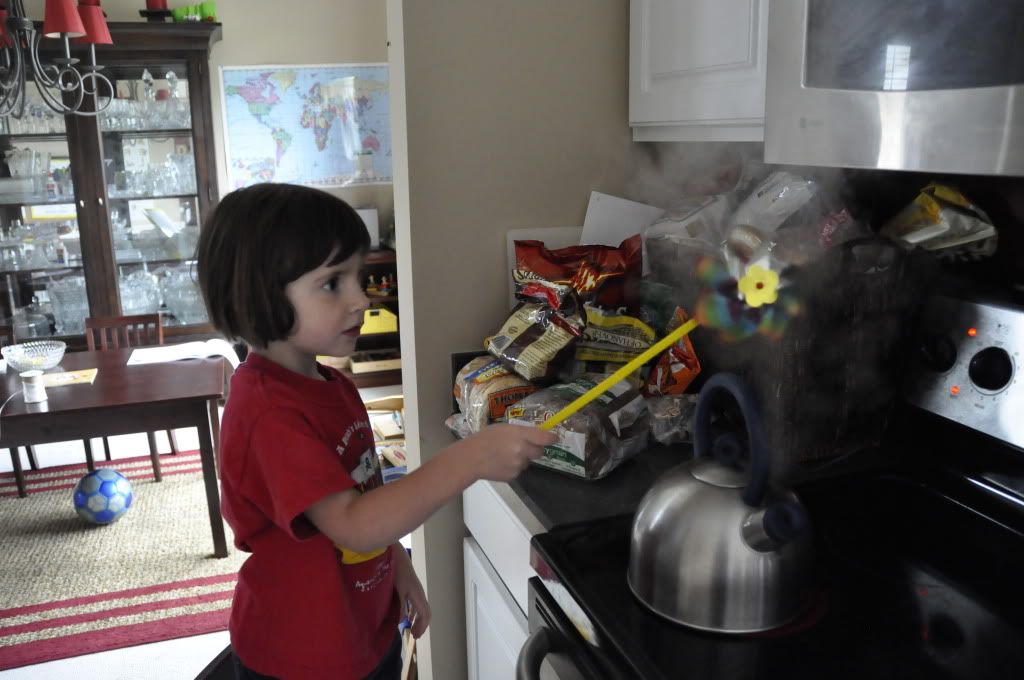
On another day, we started to talk a bit more about how steam can be used to power things.   To illustrate this in a way that a 3 or 4 year old could understand, I put the tea kettle on and we watched how the boiling water could actually turn a pin wheel.  We also talked a bit about how when water is heated it expands building pressure.

I also stumbled upon a GREAT resource for explaining steam power from our local library.  it is a short video called  The Way Things Work:  Steam Power.  It is an animated movie where some kids need to find a way to power the rides and attractions at their fair.  They turn to steam power and the book does a great job of illustrating the basics of steam engines.  I am not sure how much Marcus and Sophie got from this video.  (It is probably more geared toward older kids.)  However, I heard them explaining steam power to their dad one night...so obviously they got something from it.  If you have older kids, I highly recommend checking to see if your library owns a copy of this video. 
THE WAY THINGS WORK : STEAM POWER (DVD)
 History- The Role of Steam Power in our History
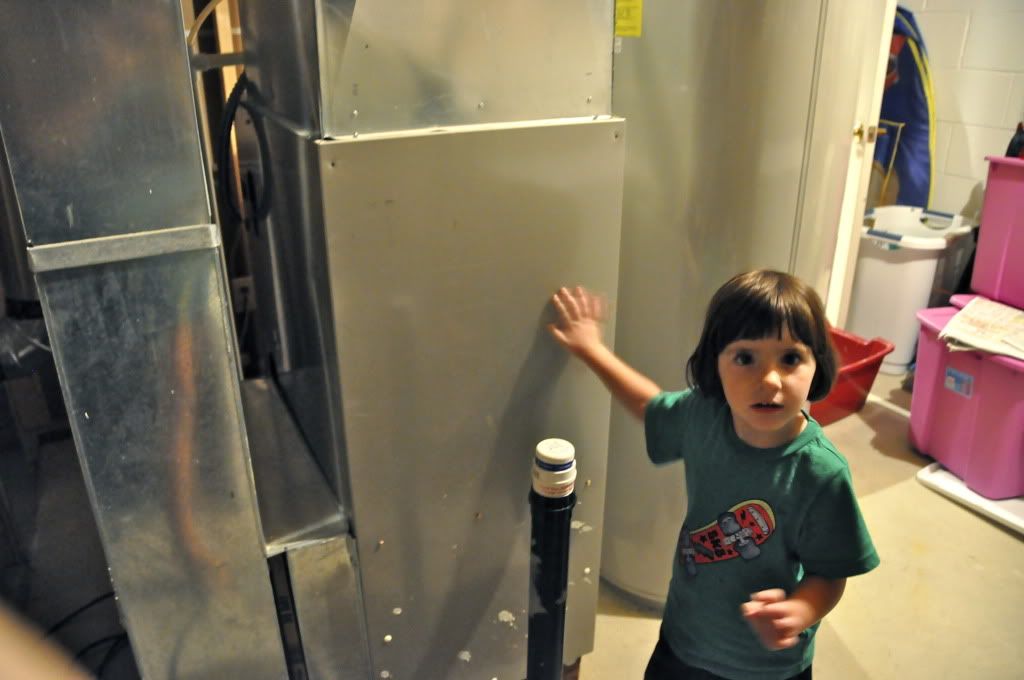

Social Studies- What is a furnace?  How is a house (or in our case a city hall) built? 
It was during this discussion that I found out that the kids didn't know what a furnace was.  (I took it for granted that they knew what a furnace was.  So I was surprised when they asked about it.)    So we took a trip down to the basement (aka our "cellar", one of our vocabulary words this week) and we checked out our furnace.  We also went around the house looking at all of the vents and talking about where the hot air came from in the winter. 
Three year Old Sophie checks out the furnace
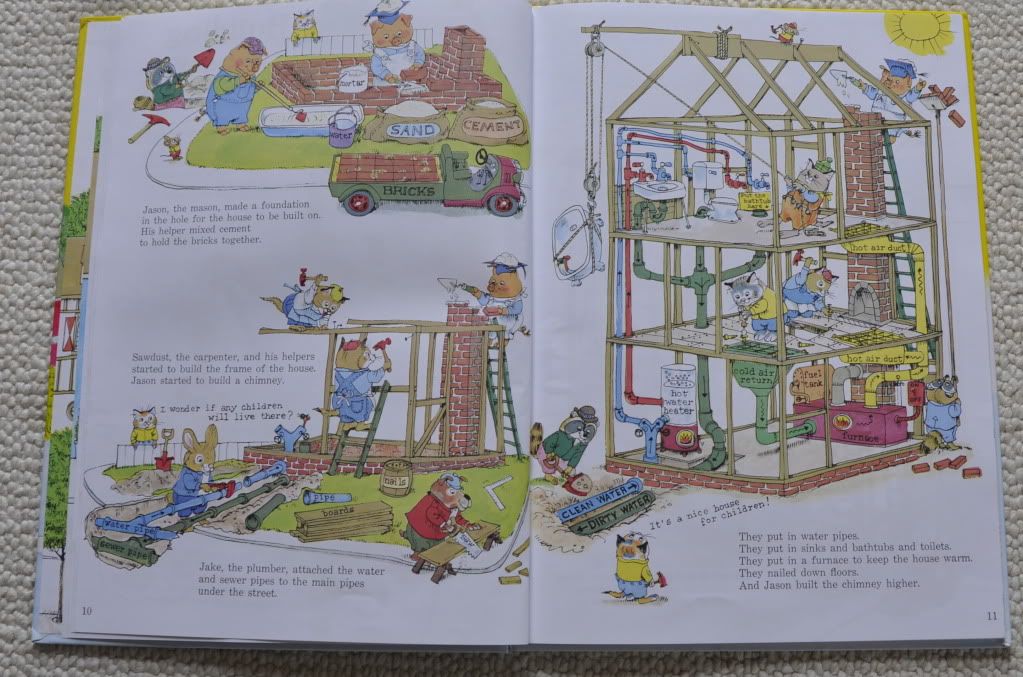
I also pulled out a book from our Sonlight curriculum called What Do People Do All Day by Richard Scary.  
Richard Scarry's What Do People Do All Day
This is an awesome book to have on your shelves.  I find that I am always pulling it out to describe various things to kids.  On page 9 & 10 of this book there is a wonderful description of how a house is built which tied in nicely with our Mike Mulligan discussion.   It also does a wonderful job of explaining how a furnace works to heat and cool the house. 

What People Do All Day has a nice illustration and description showing what a furnace is
Social Studies- Character:  Stewardship
Good stewardship is taking care of the things we own and the resources we have to use.   We went to the picture of the book where all of the other steam shovels were being scraped for junk.  Then we discussed how Mike loved his steam shovel and took good care of it.  Because he cared for his steam shovel, she lasted for a long time.  While other steam shovels were being scrapped, Mary Anne could still dig "as much in one day as a 100 men could dig in a week." 

Geography:  The Panama Canal
In the book, Mike Mulligan and Mary Anne and some others help dig the canals for the large boats to come through.  Canal became one of our vocabulary words for the week.  We also located one of the most famous canals (The Panama Canal) on the map and put a story disc from Mike Mulligan and his steam shovel on it.  I am not sure if the fictional Mary Anne actually was supposed to have dug this famous canal...however, I hoped it would help the kids remember what a canal was. 


Language Arts- Vocabulary Words
We added the following vocabulary words to our word box.  


  • Evaporate-from our science experiment
  • Condense-from our science experiment
  • Expands-from our science experiment
  • Furnace
  • Canal
  • Cellar

Language Arts-Personification
We also discussed what the literary technique of personification means.  While reading the book, Marcus and Sophie kept asking if the steam shovel "could talk".  (I think because the steam shovel had a face and even a mouth.)  So we discussed that the author used a technique known as personification where she gave human attributes to a thing.  (In this case, a steam shovel was given human features and a personality.) We spent some time flipping through the book and looking at how Virginia Lee Burton illustrated the different expressions on Mary Anne's face. 
Mary Anne is a very expressive steam shovel!  She is illustrated with many different facial expressions showing a wide range of human emotions.  She is also an excellent example of personification. 

Art- Music
Alright, this is the one resource that I found that I was SO excited about.  There is a series called "Stories in Music" where they attempt to introduce children to music by composing music for the story while a narrator reads aloud the book.  Well...they have one of these for Mike Mulligan and it is awesome!  This CD tells the story of Mike Mulligan using an original composition of music played by the London Philharmonic Orchestra.  (Very similar to how the story Peter and the Wolf is told through music if you are familiar with that.)  I was surprised that I have never heard this CD mentioned on any of the FIAR message boards or blogs.  
Stories in Music: Mike Mulligan and His Steam Shovel (Audio CD and Paperback Book)


Sensory Play
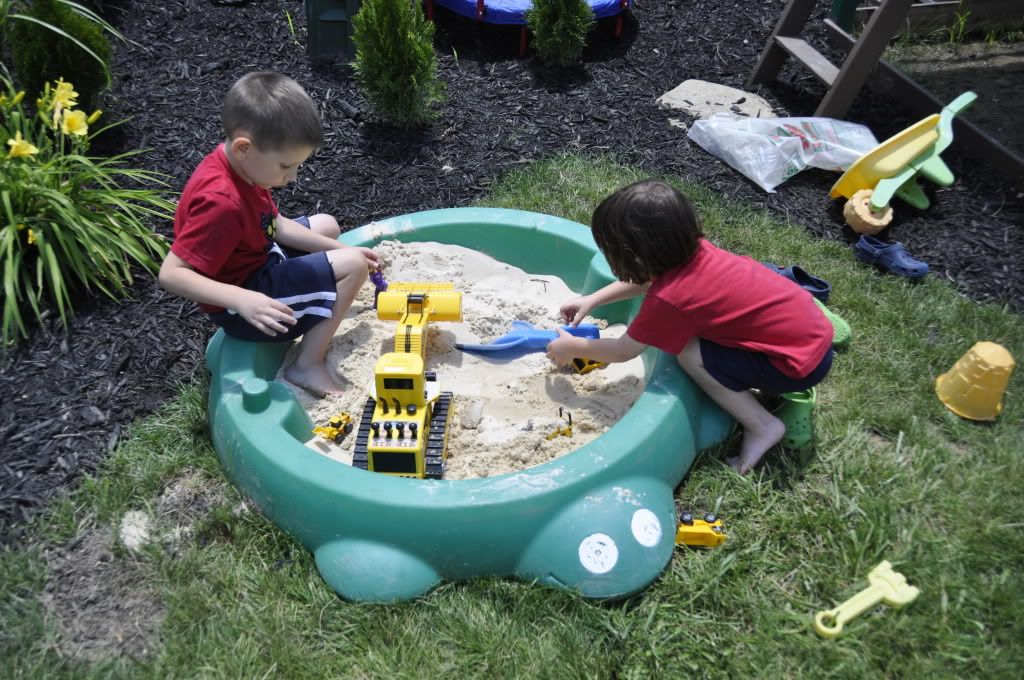
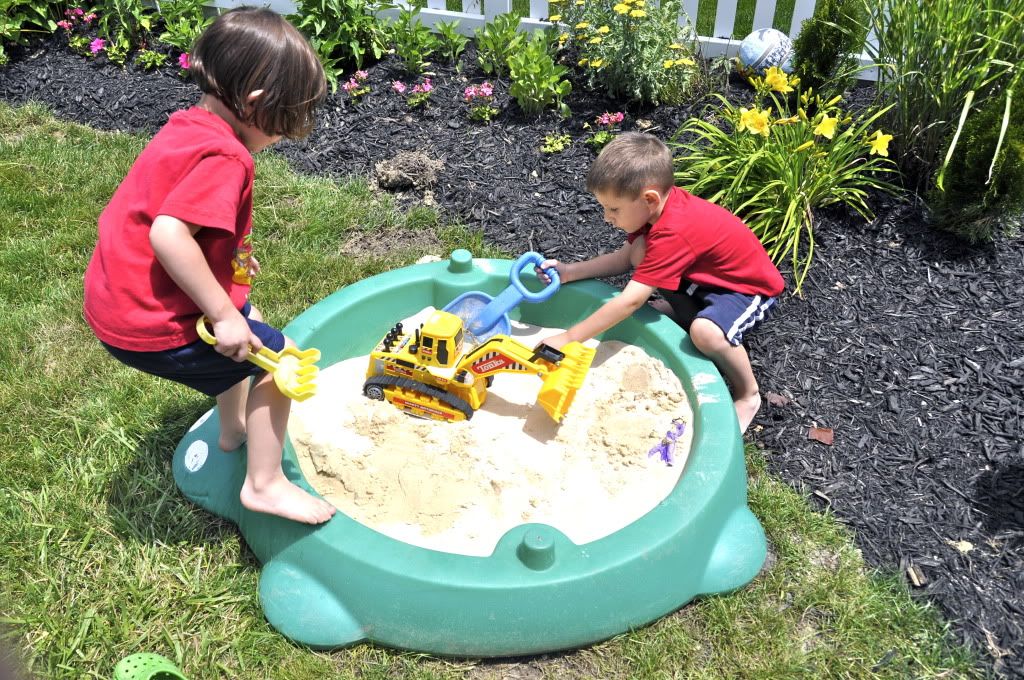
I finally got around to cleaning out the kids sandbox and filling it with new sand.  I then put a couple of "steam shovels", bulldozers, backhoes, and other trucks in the sandbox hoping to encourage them to re-enact the story we read.   Marcus decided to do his own version of the story.  The sandbox became Egypt.  And from what I overheard, the trucks had uncovered some mummies and sand monsters.  A few moments later, he ran downstairs and got several toy dragons and they were added to his "Egypt". 

Field Trip-The Science of Big Machines
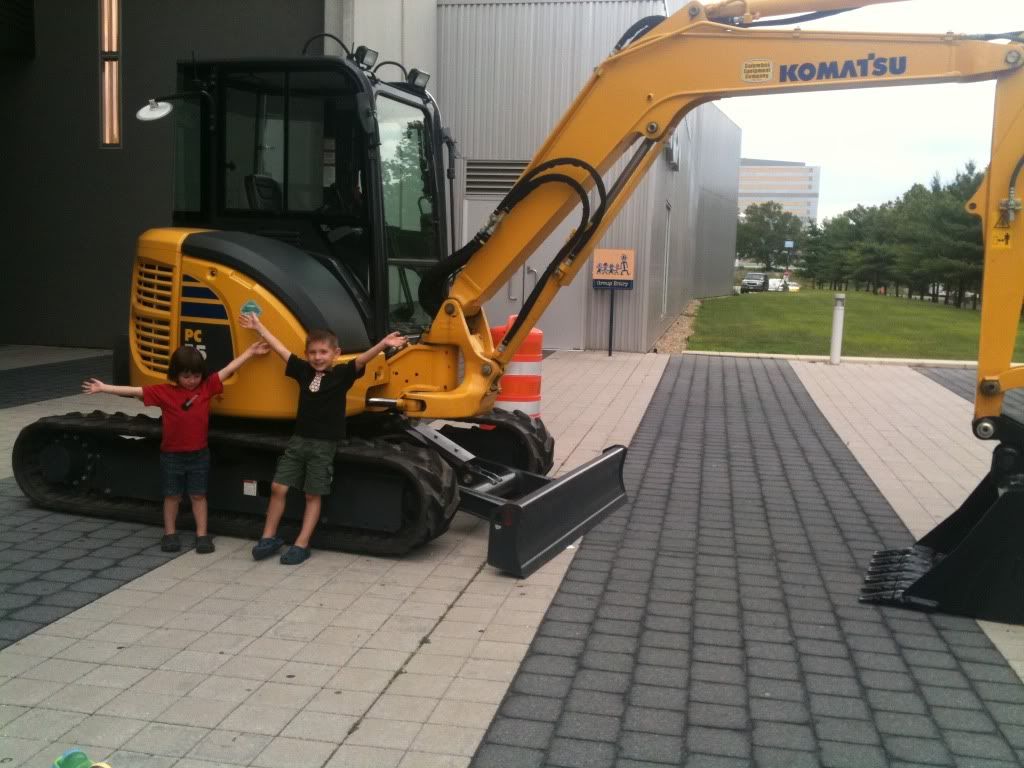
Our local science museum had an exhibit this week called "The Science of Big Machines".  And to tell you the truth, this is one of the reasons I decided to row Mike Mulligan this week.  I thought it would make an awesome field trip to go along with the book.
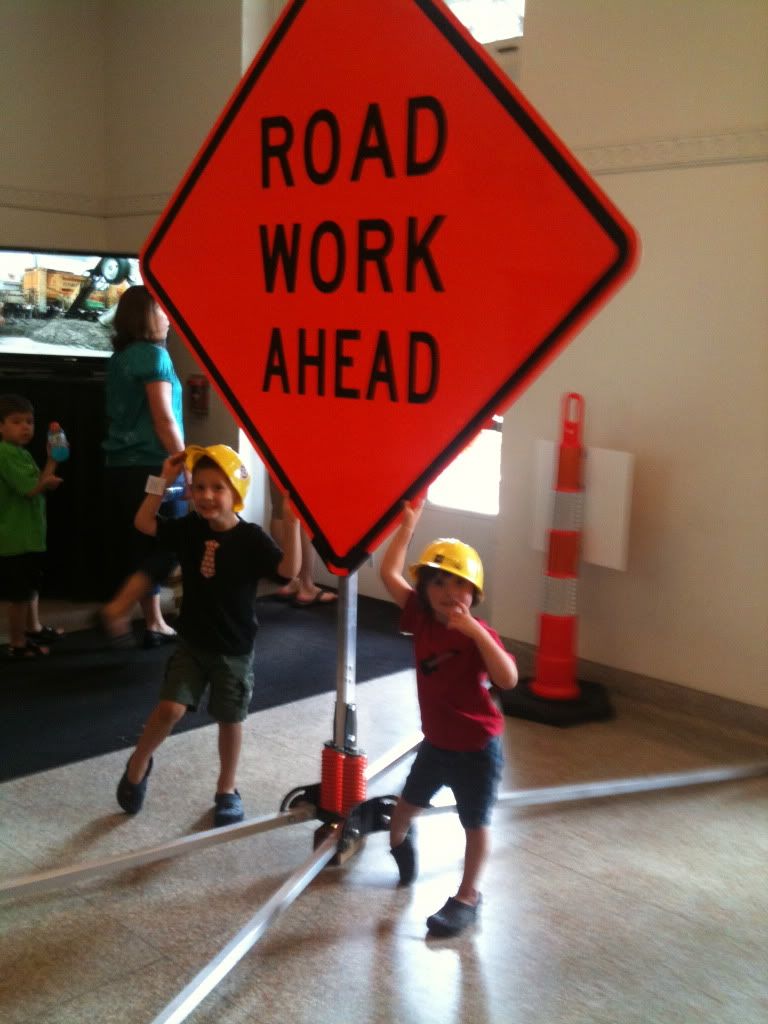
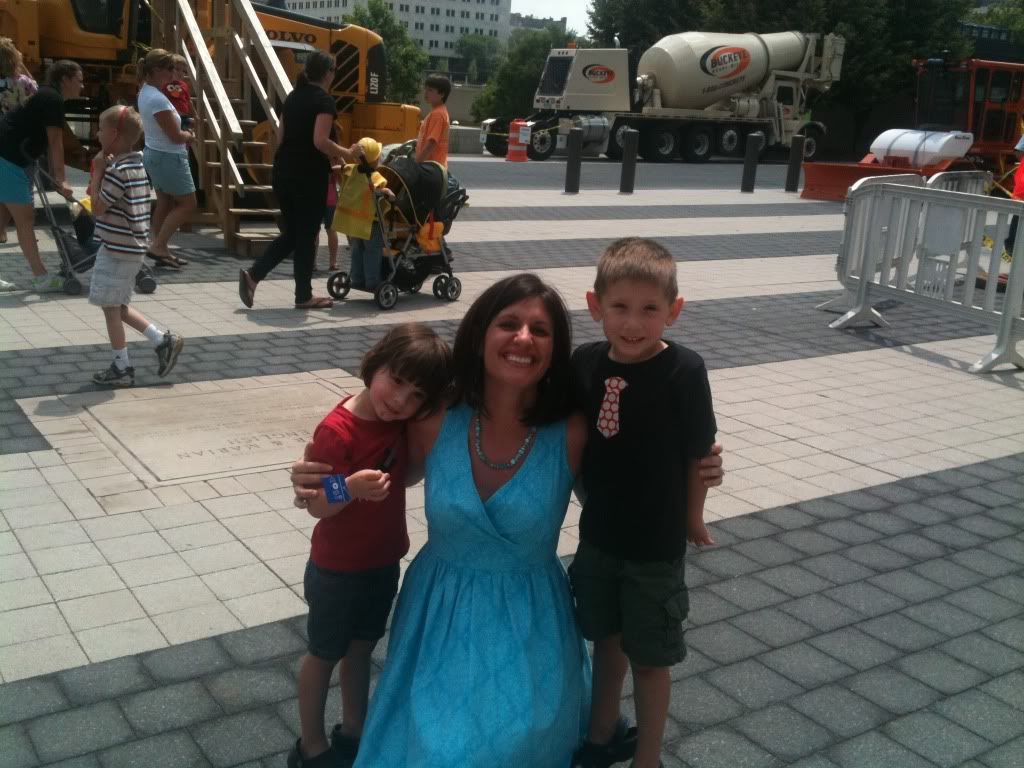
Marcus and Sophie on their Mike Mulligan Field Trip


When the kids arrived at the exhibit they were given yellow hard hats to wear.  They then got to walk around and experience some BIG construction machines up close and personal. 
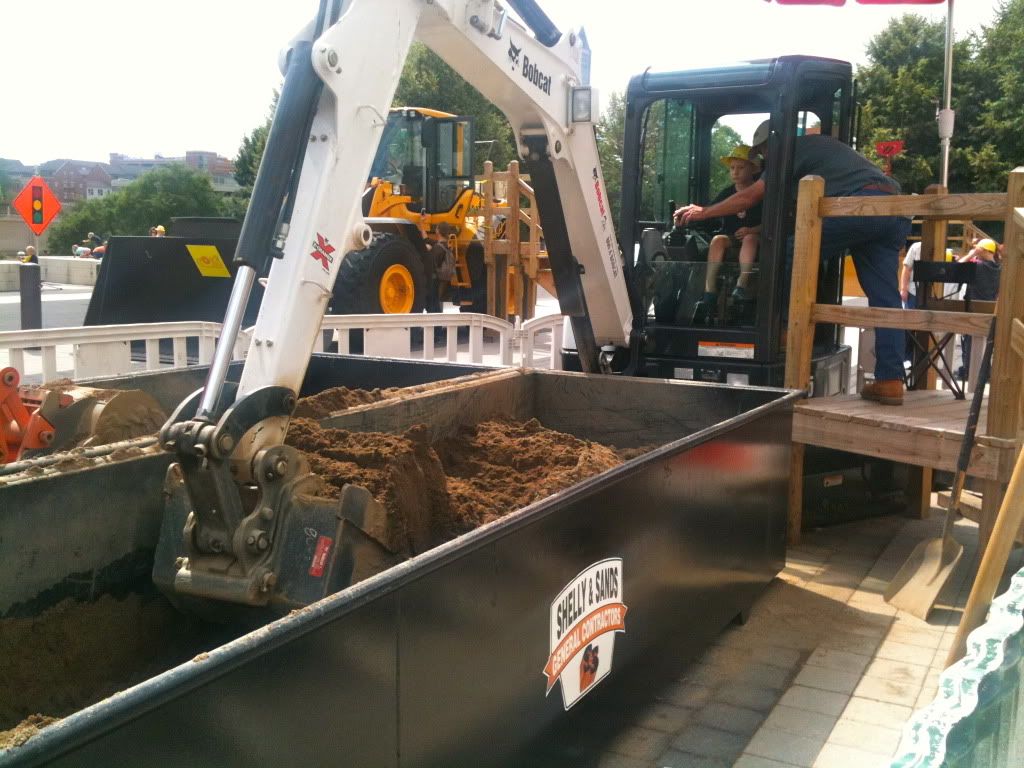
 The best part of the field trip was when Marcus and Sophie got to operate a real diesel excavator.  (The modern day equivalent of a Steam Shovel.)   They used the excavator to dig a hole and then smooth down the dirt again.
Here is a picture of Marcus running the excavator. 
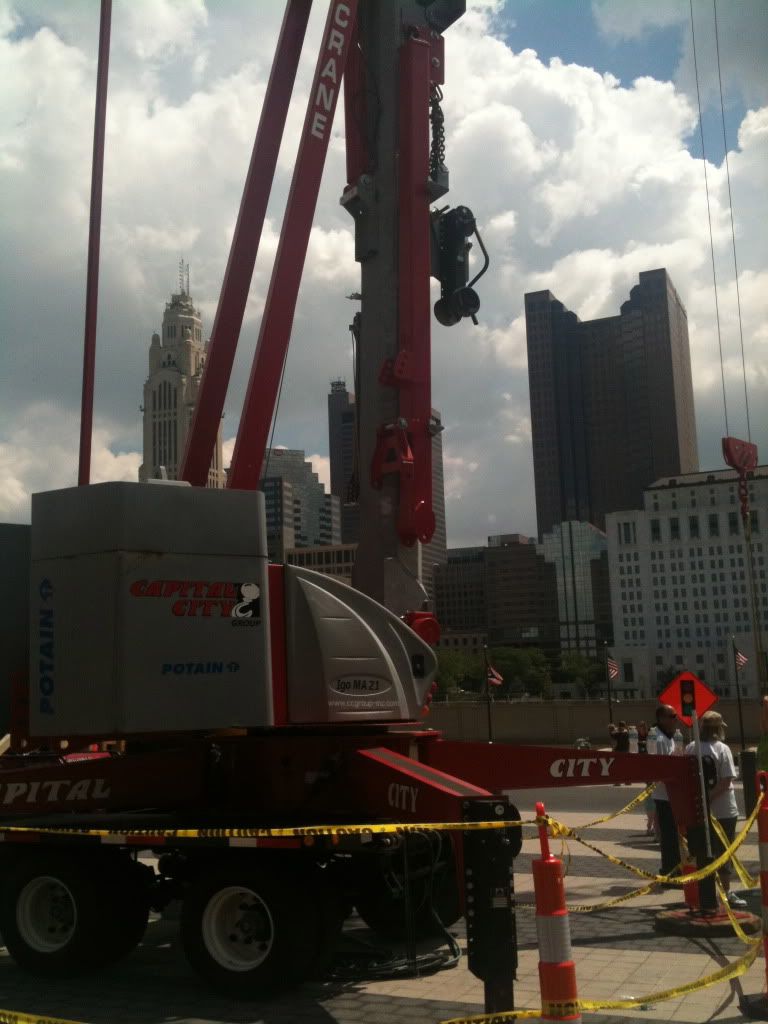
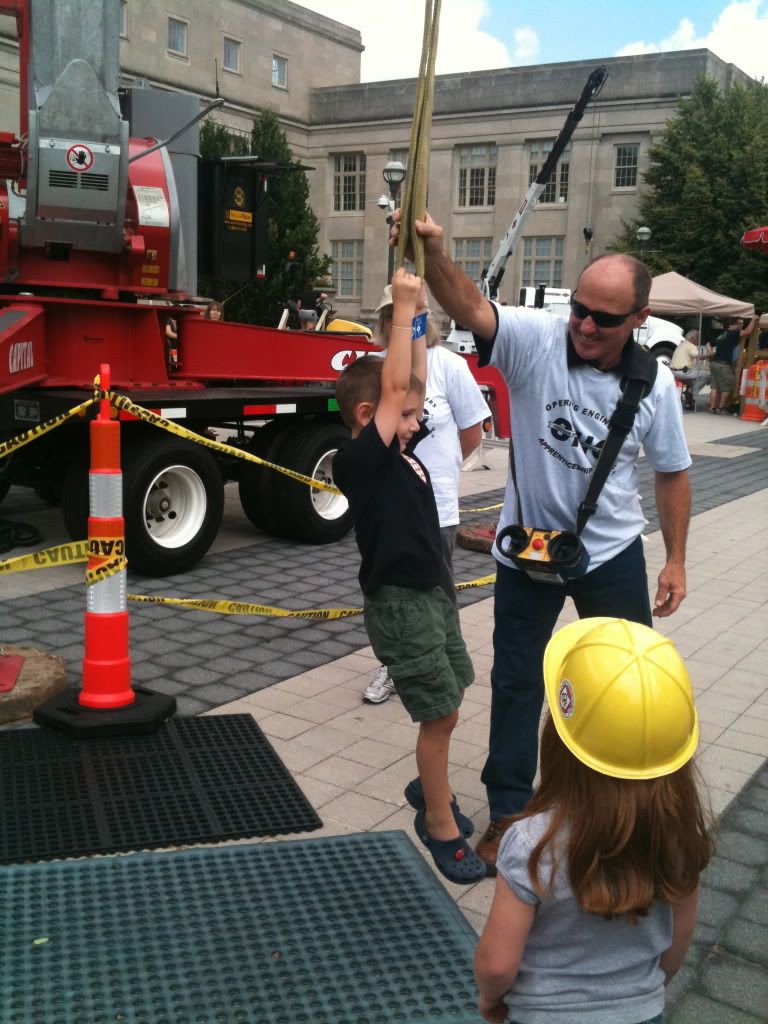
 Another highlight was when Marcus was lifted off the ground by a giant crane. 

The crane was SO big that no matter how far I stood back I couldn't get it all in the frame of the camera! 
Here Marcus is being lifted off the ground by the crane.
The kids even got a chance to eat a box lunch "construction worker" style.

We all had a great day together.
Making Memories- A Mike Mulligan Dinner Party:
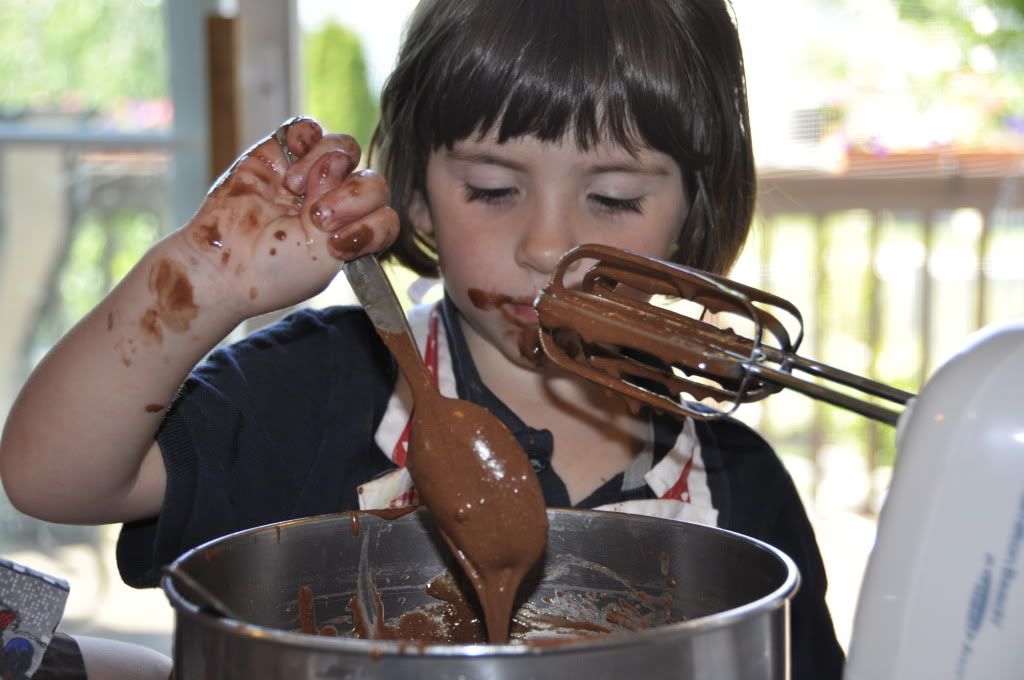
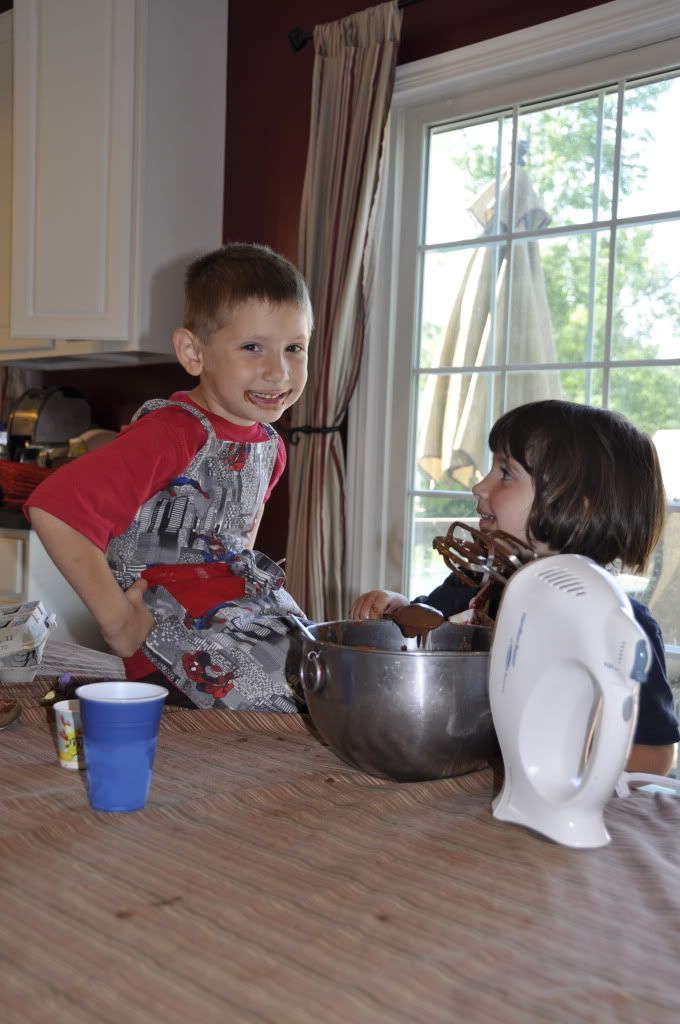
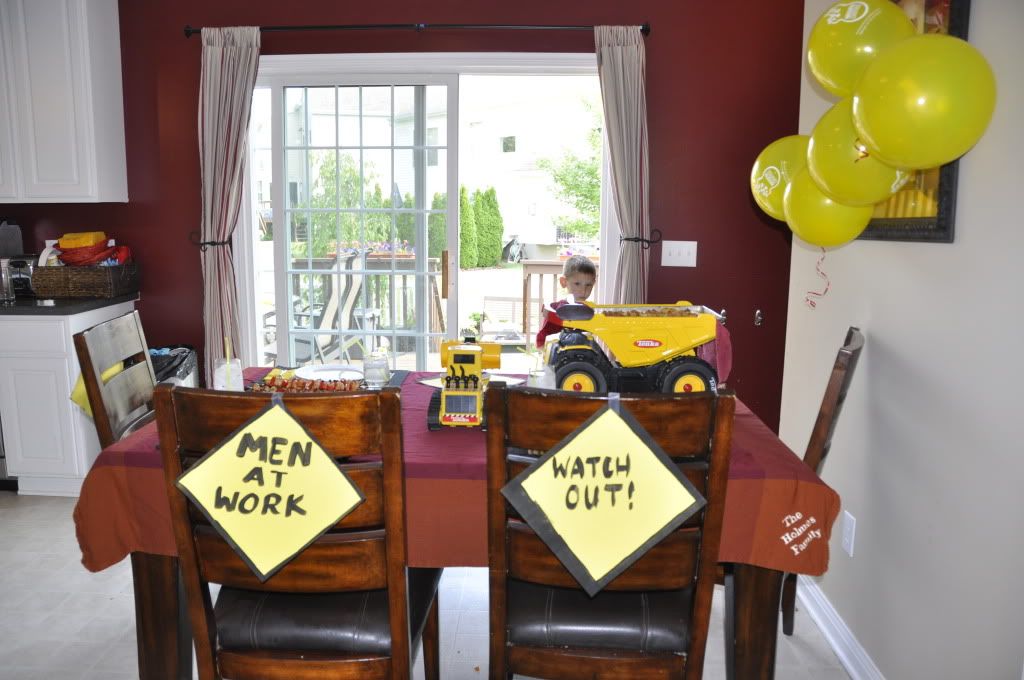
On Friday, the kids helped me to throw a Mike Mulligan party.  It was going to be Father's day this weekend, and we are always looking for excuses to have a party.  We started the afternoon off by baking a chocolate cake for our party.  
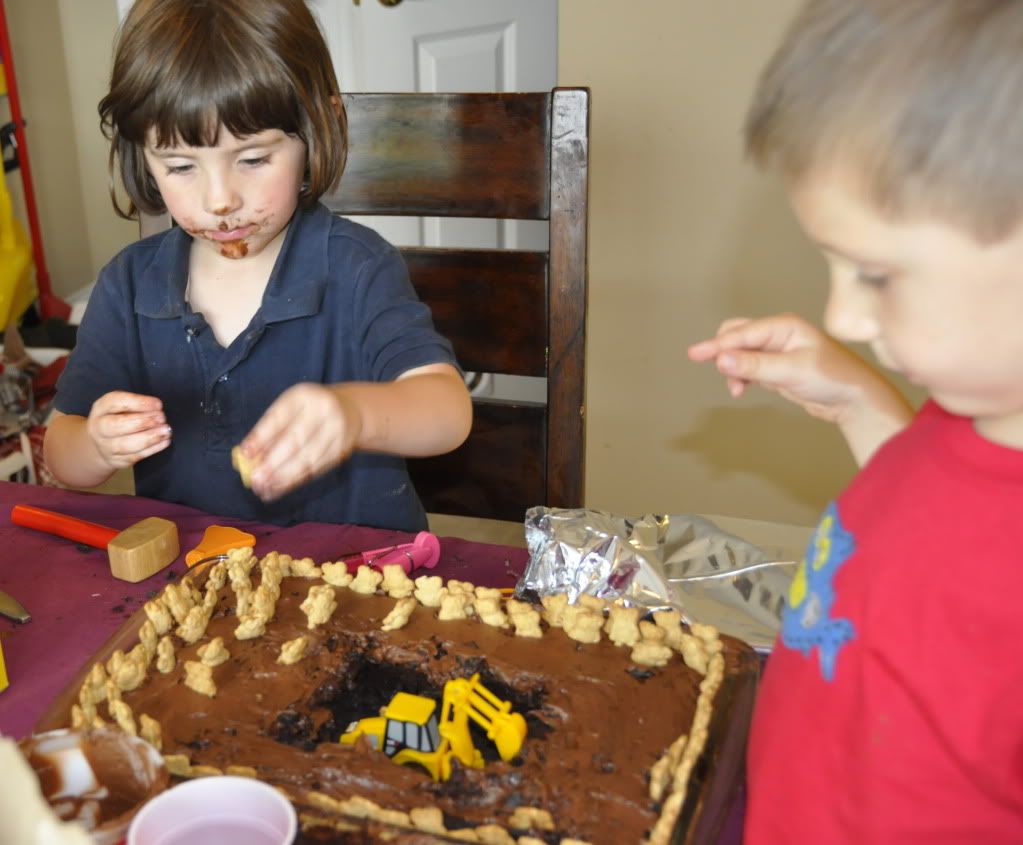
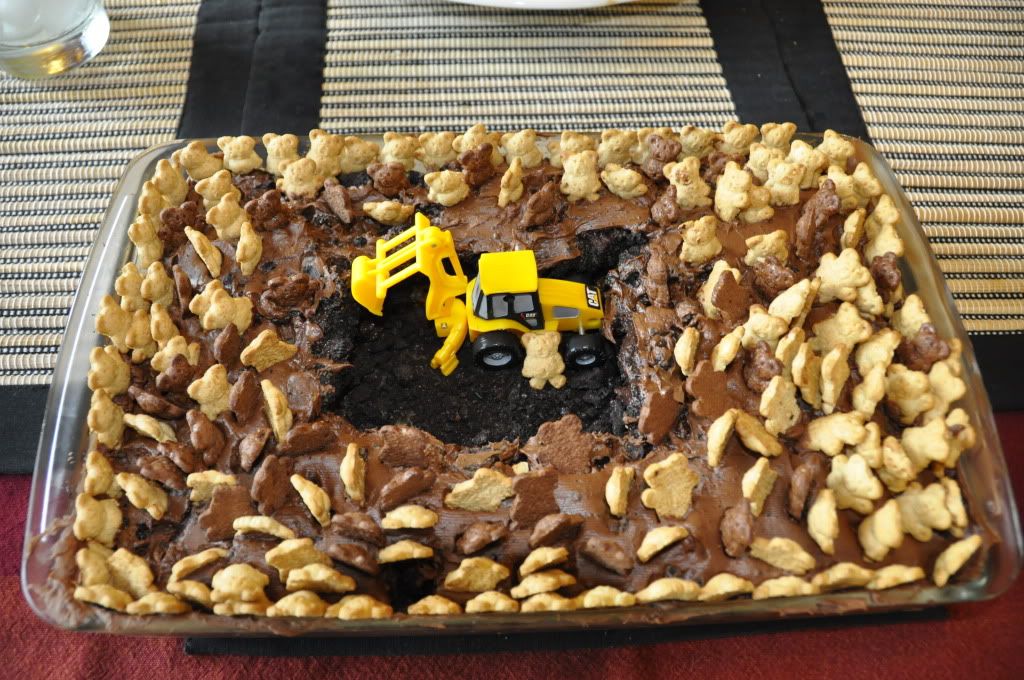
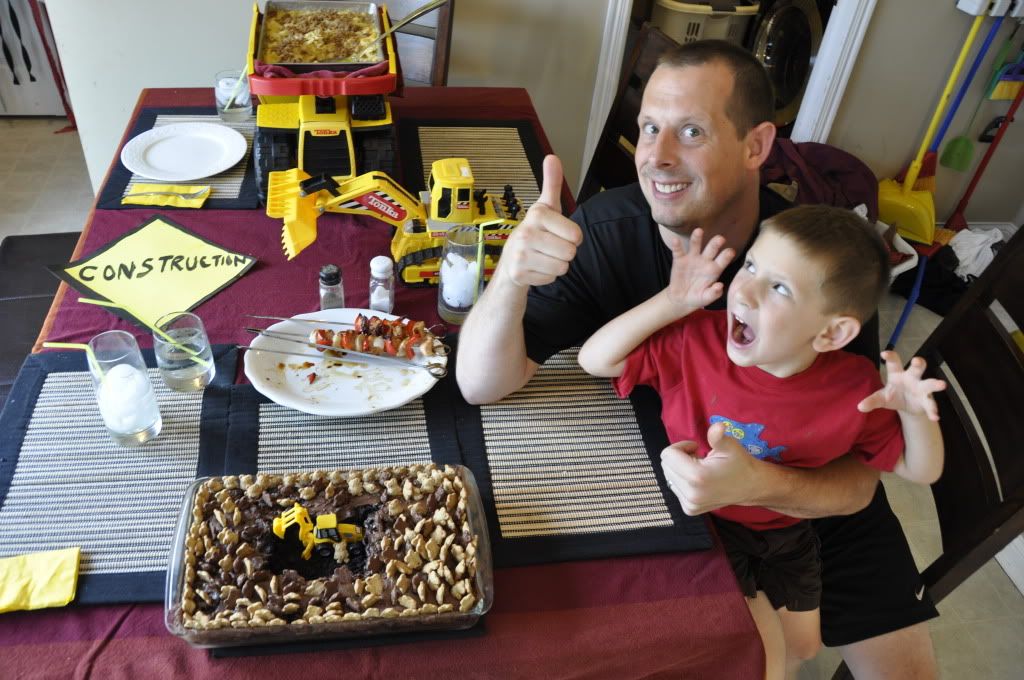
After the cake baked, we layered it with dirt (aka crushed Oreo cookies) and mud (aka Chocolate moose).   In the story, Mary Anne digs the cellar of the Popperville town hall with "four corners neat and square".  So the kids helped me cut out a square in the center of the cake to represent our cellar.
We also used Teddy Graham cookies to represent the people of Popperville who stayed to watch Mary Anne as she dug.  We put a little toy "steam shovel" in the bottom of our cellar (Mary Anne) and another bear that we said was Mike Mulligan in the cellar with her.  Now the cake is supposed to look like this cake.  However, Marcus reminded me that the citizens of Bangerville and Bopperville and Kipperville and Kopperville all came to watch Mary Anne dig too.  Therefore, he said, we were going to need A LOT more bear cookies on our cake. 
 So our version of the caked ended up looking like this: 
Perhaps not the prettiest Mike Mulligan cake on the web.  However, the kids enjoyed EVERY second of making this cake.
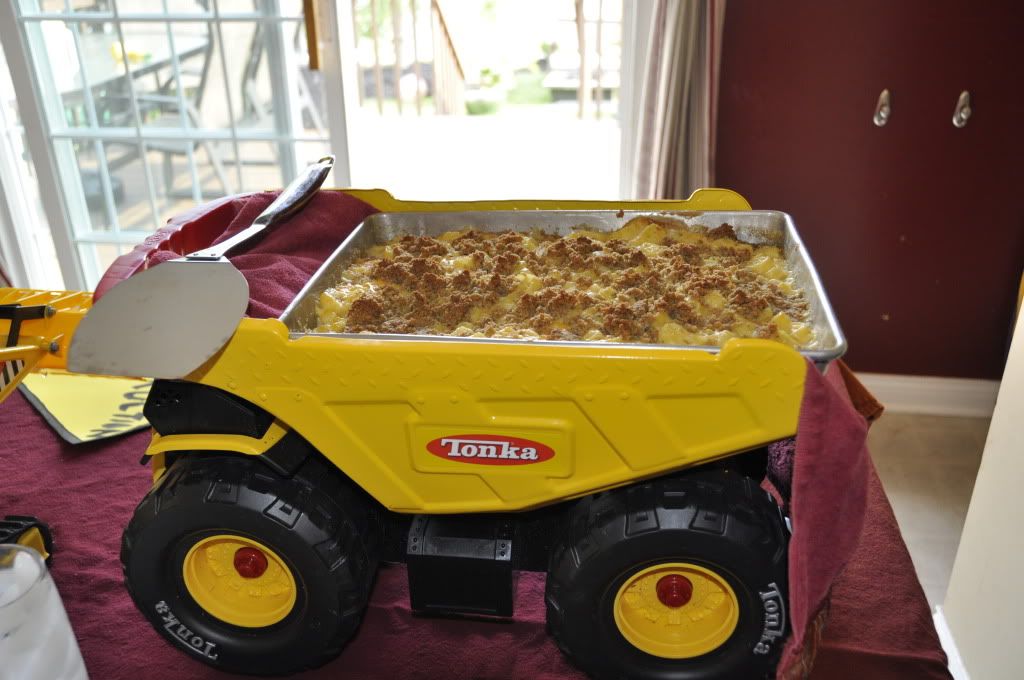
I also made "Dump Truck" Macaroni and Cheese.  (It was basically baked Macaroni and Cheese made with noodles shaped like wheels.  I also sprinkled it with a mixture of Italian bread crumbs and melted butter before baking to represent sand...and also to make it taste YUMMY!)  I served the dish in a pan in the back of a toy dump truck that we owned.
Dump Truck Mac and Cheese
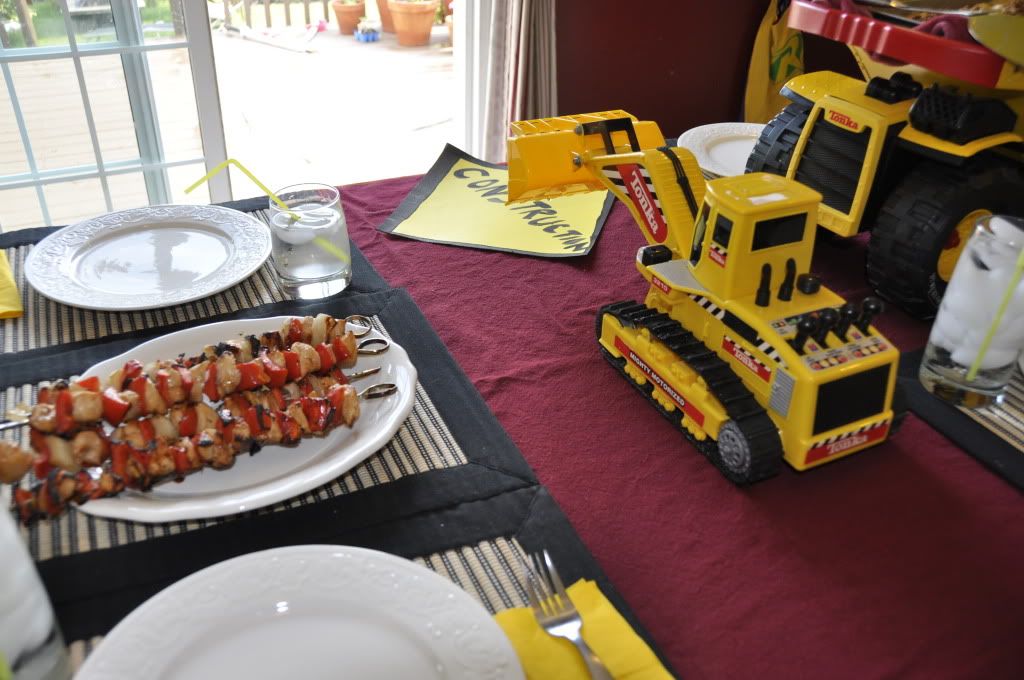
Our dinner was completed with some boulder kabobs (chicken kabobs made on the grill).
Chicken "Boulder" Kabobs
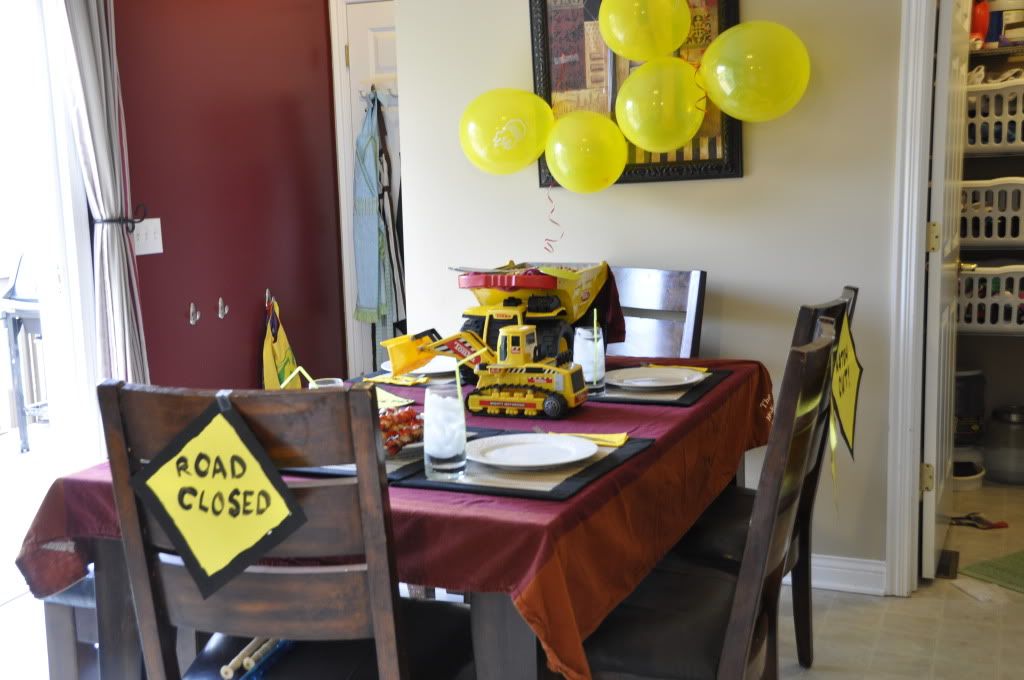
The kids also helped me paint construction signs using a piece of poster board.  And we blew up some balloons that we had left over from a birthday party.
Our painted construction signs

Dad and Marcus getting ready to dig into some cake
Well everyone, that wraps up our week with Mike Mulligan and his Steam Shovel.  I hope you have your own adventures with this wonderful book! 

Links to Become Attached To:
Tot School
Preschool Corner
Homeschool Share (TONS of FIAR resources)
Link N' Learn


Blog Template by BloggerCandy.com